
Extractor rod wobble

CrowGhost

Member
Joined
Feb 12, 2026
Messages
59
Reaction score
71
City & State/Province
United States
I unfortunately had to replace my model 29-5's extractor rod due to a really bad scratch in the old one that made ejection gritty. It's also very ugly and I doubt cold blue would hold up in such a high friction area.

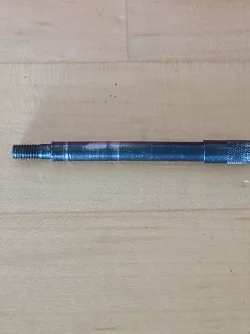
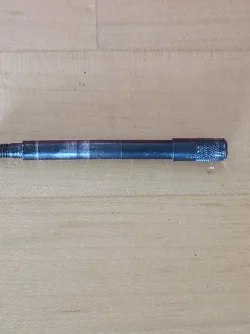
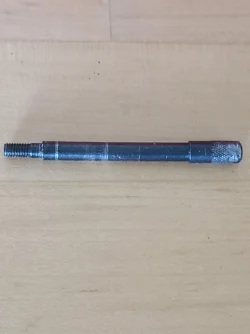
Bought a brand new factory ejector rod and noticed it wobbles slightly when rotating the cylinder. It doesn't seem to affect lock up, function, or ejection in any way. Is this normal? Or should I look into straightening it further?

I have attempted to straighten them out in the past with less than stellar results. I would find the high spot, clamp them in my rubber-jawed vice, and smack them with a brass mallet. I couldn't get them to move nearly enough to make any perceptible difference. Was thinking of maybe picking up the $150 power custom set up for yolk and ejector adjustment... but it's also $150
 
Make sure it is fully seated & tight and no burrs or such. Try it in the extractor, out of the cylinder to see if it is seated. Depending on whether you hand tighten or not, I would try more torque. In a Powers Custom video, 45 inch/pounds was suggested I believe. Also, you can put the rod in a drill and observe how much wobble you have compared to a drill bit. You can hold it or clamp it oriented so the rod is aligned with a straight line for reference if needed.

If you watch the Powers video and see how the alignment tool works I think you can figure out how to straighten or correct the wobble if need be without the tool.
 
Make sure it is fully seated & tight and no burrs or such. Try it in the extractor, out of the cylinder to see if it is seated. Depending on whether you hand tighten or not, I would try more torque. In a Powers Custom video, 45 inch/pounds was suggested I believe. Also, you can put the rod in a drill and observe how much wobble you have compared to a drill bit. You can hold it or clamp it oriented so the rod is aligned with a straight line for reference if needed.

If you watch the Powers video and see how the alignment tool works I think you can figure out how to straighten or correct the wobble if need be without the tool.
Good advice. I'll definitely try it in a drill!
 
I just replaced an ejector rod in a Ruger Security Six, but it was clearly out of true. I bought a factory new replacement, but it was perfect...maybe your replacement should go back?
I have another being delivered today. We'll see if the first was a dud
 
We were advised in S & W factory armorer training, and I have this in my copious notes that I wrote down, that the extractor rod "lives" in a revolver. Some require the extractor rod to be very straight, some don't.
So, if an extractor rod has a little wobble to it, and the cylinder has no rotational bind and the revolver functions fine, then it is OK. No need for a perfectly straight extractor rod for that particular revolver.

I've personally observed several revolvers, over the years, that did not have a perfectly straight extractor rod and they functioned fine without any rotational bind.
 
We were advised in S & W factory armorer training, and I have this in my copious notes that I wrote down, that the extractor rod "lives" in a revolver. Some require the extractor rod to be very straight, some don't.
So, if an extractor rod has a little wobble to it, and the cylinder has no rotational bind and the revolver functions fine, then it is OK. No need for a perfectly straight extractor rod for that particular revolver.

I've personally observed several revolvers, over the years, that did not have a perfectly straight extractor rod and they functioned fine without any rotational bind.
great info!! Thank you!!!!
 
Very few extractor rods are actually bent. The offset normally occurs in the mating of the threaded coupling between the ejector rod and extractor. Any time the ejector rod comes loose or is removed, there's a good chance it won't run true upon tightening or reassembly. The easiest and best way to get it running true is the Ron Power tool.
 
Very few extractor rods are actually bent. The offset normally occurs in the mating of the threaded coupling between the ejector rod and extractor. Any time the ejector rod comes loose or is removed, there's a good chance it won't run true upon tightening or reassembly. The easiest and best way to get it running true is the Ron Power tool.
Gotcha, so it's possible that even the new one I will be receiving today won't be straight?
 
The bent ones I've seen probably got that way through use or misuse, but all bets are off on new parts these days.
The new ones I have gotten were straight. There is a bit of play between the male and female threads, and this is usually where the crookedness originates.

Each part is an entity unto itself, and can be anything it wants to be. There is no guarantee of anything.
 
I would have tried stoning the burr and then cold blueing it first, so what if you had to apply CB every few years. Unless it was terrible, I'd bet it was hardly noticeable. Little things can catch our eyes, get under our skin and become a problem that wasn't really one to begin with.
 
I would have tried stoning the burr and then cold blueing it first, so what if you had to apply CB every few years. Unless it was terrible, I'd bet it was hardly noticeable. Little things can catch our eyes, get under our skin and become a problem that wasn't really one to begin with.
It's pretty bad. I actually did try cold bluing it and it scraped right off. I followed all the steps. Not sure what I did wrong
 
Extractor rods are somewhat easily and successfully straightened. As far as bluing is concerned, that wears off anyway as the revolver is used.
I seem to lack the tools. I tried with a brass tipped hammer and my vise to no avail. It's so very slight I may just leave it. If it bothers me that much I'll pick up the Powers yolk/ejector rod tool.

That being said, another user mentioned it was likely the relationship between the threads of the extractor star and the rod that cause the slight wobble.

The Powers tool would certainly help me make it true now that it has been installed, but it's barely visible and doesn't affect function. I'm bad at "leaving well enough alone." Though maybe I should practice that here
 
I seem to lack the tools. I tried with a brass tipped hammer and my vise to no avail. It's so very slight I may just leave it. If it bothers me that much I'll pick up the Powers yolk/ejector rod tool.

That being said, another user mentioned it was likely the relationship between the threads of the extractor star and the rod that cause the slight wobble.

The Powers tool would certainly help me make it true now that it has been installed, but it's barely visible and doesn't affect function. I'm bad at "leaving well enough alone." Though maybe I should practice that here
2 new ejector rods cost me $20.
 
CrowGhost,

You are making far too much out of something that really is no problem. First, a bit of correct nomenclature: What you are talking about is correctly the extractor rod, not ejector rod. What you refer to as "wobble" is correctly called run out.

There is some clearance within the yoke to allow for this/ No matter what you do the extractor rod will always rub inside the yoke and wear the bluing off, that is the cost of using the gun. Finally there is some clearance between the extractor and extractor rod threads. Most times the extractor rod run-out can be fixed by simply loosening the extractor rod and re-tightening, then re-check the run-out. You may have to do this 2-3 times.
 
CrowGhost,

You are making far too much out of something that really is no problem. First, a bit of correct nomenclature: What you are talking about is correctly the extractor rod, not ejector rod. What you refer to as "wobble" is correctly called run out.

There is some clearance within the yoke to allow for this/ No matter what you do the extractor rod will always rub inside the yoke and wear the bluing off, that is the cost of using the gun. Finally there is some clearance between the extractor and extractor rod threads. Most times the extractor rod run-out can be fixed by simply loosening the extractor rod and re-tightening, then re-check the run-out. You may have to do this 2-3 times.
Interesting. Thanks for the info. I'll try loosening and retightening
 
I unfortunately had to replace my model 29-5's extractor rod due to a really bad scratch in the old one that made ejection gritty. It's also very ugly and I doubt cold blue would hold up in such a high friction area.

Bought a brand new factory ejector rod and noticed it wobbles slightly when rotating the cylinder. It doesn't seem to affect lock up, function, or ejection in any way. Is this normal? Or should I look into straightening it further?

I have attempted to straighten them out in the past with less than stellar results. I would find the high spot, clamp them in my rubber-jawed vice, and smack them with a brass mallet. I couldn't get them to move nearly enough to make any perceptible difference. Was thinking of maybe picking up the $150 power custom set up for yolk and ejector adjustment... but it's also $150
Be mindful that the threaded portion is very thin and easily broken!
 
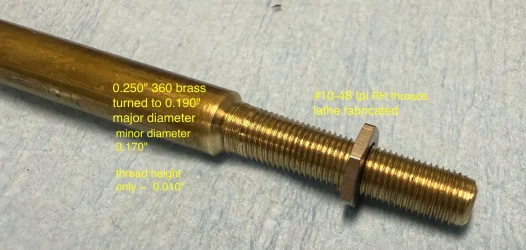
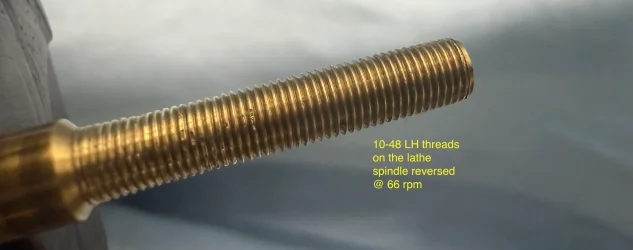
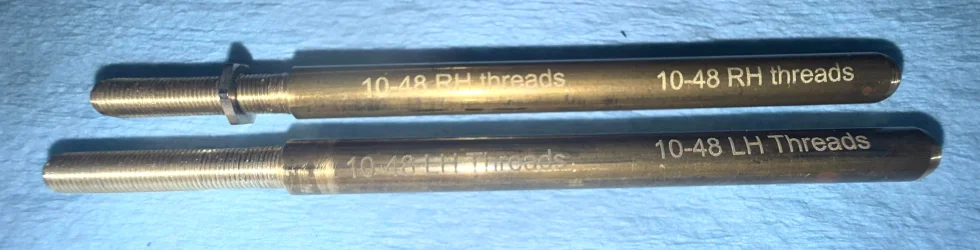
I recently went down the extractor rod 10-48 tpi rabbit hole with the lathe, taps & dies etc. just for the heck of it.

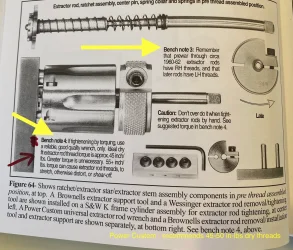
The rod threads are only ~0.010" high, so Kuhnhausen cautioned "torque can cause the extractor rod threads to stretch, otherwise disort, or shear-off."

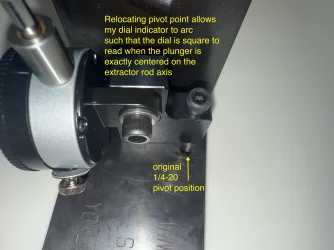
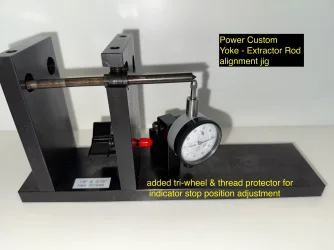
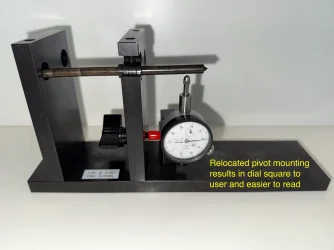
10-48 1:4 360 brass threaded on lathe 05.16.26IMG_6507 2 copy.webpIMG_6703 2 copy.webpIMG_6708 2 copy.webpExtractor Rod Torque Values Kuhnhausen versus Power Custom copy 2 2.webp
 
Last edited:
CrowGhost,

You are making far too much out of something that really is no problem. First, a bit of correct nomenclature: What you are talking about is correctly the extractor rod, not ejector rod. What you refer to as "wobble" is correctly called run out.

There is some clearance within the yoke to allow for this/ No matter what you do the extractor rod will always rub inside the yoke and wear the bluing off, that is the cost of using the gun. Finally there is some clearance between the extractor and extractor rod threads. Most times the extractor rod run-out can be fixed by simply loosening the extractor rod and re-tightening, then re-check the run-out. You may have to do this 2-3 times.
Update:

Tried this, loosened and tightened quite a few times and did notice a very light variation.

I got it so close that I can't tell if the runoff is being caused by the slight play in the yolk/ejector relationship or anything else. I'd say that's probably good enough. Less than a half mm
 
I seem to lack the tools. I tried with a brass tipped hammer and my vise to no avail. It's so very slight I may just leave it. If it bothers me that much I'll pick up the Powers yolk/ejector rod tool.

That being said, another user mentioned it was likely the relationship between the threads of the extractor star and the rod that cause the slight wobble.

The Powers tool would certainly help me make it true now that it has been installed, but it's barely visible and doesn't affect function. I'm bad at "leaving well enough alone." Though maybe I should practice that here
Using a brass hammer to straighten out an ER is difficult because the brass is softer than the steel and won’t really do much. You need to use a SMALL steel Ball Peen hammer to effectively do the job. You also need to use a steel block or vise anvil to do it on. Don’t hit the ER very hard-a little at a time and keep roll testing your progress.
 
Back
Top