Force-on-force training?

How have you trained in preparation for an armed encounter?

  • I don't train, I feel that I can do whatever has to be done.

    Votes: 6 13.3%
  • I practice against paper targets.

    Votes: 15 33.3%
  • I participate in combat-style style time plus,matches, such as IDPA, USPSA, PPC, and GSSF.

    Votes: 9 20.0%
  • I have trained in a shoot house against a live adversary using simunitions.

    Votes: 15 33.3%

  • Total voters
    45
  • Poll closed .

lrrifleman

Member
Joined
Oct 14, 2015
Messages
4,886
Reaction score
4,435
City & State/Province
Southern NJ
We frequently see a question in this forum along the lines of, "do you carry with a round chambered "?

Everyone has their opinion, and I don't fault their opinion. However, I have to wonder how respondents have trained which have led to this opinion. Hence, I've put together this survey.

For me, I have participated in combat-style matches (IDPA, USPSA, and GSSF) where it has been just me against the clock, with scoring being time plus penalty. Then, I had the opportunity to take a force on force class which put me in the shoot house against a live adversary using simunitions.
 
Since I only carry an auto for self defense, I carry them the way they're designed to carry.
Locked and Cocked.
 
I don't train. I carry my draw and fire semi autos with a round chambered. I think if I ever have to use one I know what to do without any formal training.
 
I'm not sure what point is being made about force on force training v chambered round. OTOH, my force on force training experience might well not be what you have in mind. A multiple choice poll about justification for the empty chamber would seem more appropriate.

I won't speculate on reasons for the practice, but an assumption that they'll always have time to chamber a round is a failure to recognize reality. Also may be viewed as an aggressive act that precipitated violence. I'd suggest a weapon retention class to treat that.
 
Last edited:
Force on force training is more like the real deal. FOF is better than Shoot Don't Shoot training, IMO.

The FOF scenarios can produce both psychological and physiological stress in anticipation and confrontation which can impact shooter skills.
 
There isn't anything around me that offers "classes" that revolve around practice/practical combat shooting, timing and such. I don't have the thousands it would take to fly cross multiple states and pay to take a class, or two (although I've always wanted to). So, for me, I practice on paper (silhouette), or cans. I use shooting drills at the range up close and personal, 10 yards and less, whenever no-one else is there.

As far as having the chamber loaded - I usually carry a revolver so it's a non-issue. I do carry a small semi-auto in the summer and it always has one chambered...
 
I will predict that any kind of “training” is way better than standing at a lane in the your favorite range and shooting a paper target at 7 yards, with your finely tuned and fondled defense handgun, while your range buddies looking on are all admiring your shots grouped in 3” circle at semi-rapid fire.

The assumption of predictability while doing force on force simulations may be the closest thing to an actual instantaneous adrenalin-pumping shoot-to-save-your-life situation.

The list of unpredicted, unprepared for actions that occur in a few seconds can be over-powering even with the best training.

I flash back to about age 15. My close next-door neighbor Bob, growing up together from early childhood, got into boxing. He would talk about it from time to time. At that time, I started weight training. I had no interest in boxing or self-defense. We were close to the same size, he was a little heavier. One day he challenged me to put on some gloves and spar with him. I was somewhat reluctant because I had never boxed before. We started off just moving around and throwing some air jabs. Then it got a little more serious with him landing a couple punches on my chest and head. My adrenaline kicked in and I threw a bunch of quick jabs right back. He was very surprised that I landed some heavy blows that he tried to avoid. What he did not anticipate and was not prepared for is that I have a 73” wing span. My punches could reach his body and his shorter arms could not reach me. After about 15 minutes we stopped. He was very surprised and taken back a little by that boxing “match”.
After that he never asked me to box with him again.

In our sophomore year in high school, we got harassed by some seniors. One day at lunch, Bob and I were playing shuffle board in the student lounge. An unprepared and unknowing senior confronted Bob and started harassing him. Bob only took his harassment for about 5 seconds, Bob through a quick punch to the guy’s face with his right hand. The guy never knew what hit him, he flew backwards landing on the floor, blood spurting from his lips. The bad news is Bob broke his hand. The good news is no seniors harassed him again.

So, you never know what you can’t know.
 
Last edited:
Carrying a round in the chamber of a 1911 style pistol is never advocated unless it is carried with the safety on. Other pistol types are different of course and can be safely carried with a round in the chamber hammer down. It just depends on the pistol type to a large extent and the experience/training of the person carrying the firearm. There was a time when it was felt wise to carry any semi-auto without a round in the chamber especially for court officers and the like. This fad quickly died because it was discovered officers that did this would forget to chamber a round before engaging a target. Muscle memory is hard to attain sometimes.

Force on force training was a catch phrase that came into existence at least 30 years ago, if not more and it did what it was supposed to do, pit one person against another or multiples. In my law enforcement time I went thru several of these scenario based situations and some were good and some not. Many of these training courses evolved into a situation where the "student" couldn't win. That was a huge mistake and turned a lot of participants off. Because I was a "Sim" instructor I noticed safety rules were becoming lax and of course if you point this out you are a non-conformist know-it-all. Full stop for me at that point. No longer was I a Sim instructor.

Force on force training is good if the rules are properly applied and the student can "win" if he/she does what they are supposed to. I would be very leery about going to just any force on force training without knowing the background of the school and instructors.

Rick H.
 
I have taken a couple of multi-day self defense with a handgun classes, as well as training to qualify to use my club's action range where IDPA, etc., matches are held.

I'll likely take more classes as visiting instructors and classes rotate through.

Above, I checked paper.
 
Most of my training has fallen under Tony Blauer’s SPEAR system, a few classes with Tony himself.

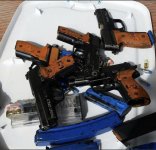
Using Ch.a.d and S.O.S methodologies, armed and unarmed…on a mat with blue guns and knifes, with marker guns and live fire.

I don’t know why you would ever carry a gun without a round in the chamber.
 
I didn't respond to the poll because the methods I use(d) weren't listed.

I've done a few IDPA matches, mainly as a learning tool and with no interest in a competitive score. I've also trained as a Correctional Officer, many years ago, which is about the same training a police officer gets. I've trained with USAF Combat Arms, also quite a while back, and I've done NRA instructor training courses. At the range (private club) I practice instinctive shooting at short ranges (15 yards and less) and at home I dry-fire and practice drawing from a holster, which the range does not permit if others are there (I do it if I am alone).

My personal defense carry is one of two handguns and I practice constantly so what I do is pretty automatic with either one. I'm getting older and slower so the muscle memory is important to maintain. I always carry my semiauto (commander size 1911) in C1 when it is on me; the other carry is a snubnose revolver.
 
When I carry a semiautomatic there is always a
round chambered.

I have learned something valuable in every class I've ever taken, but force on force training has been the most eye opening for me.

I practice regularly with a like minded local group. I train whenever I have the opportunity.
Training innvolves new skills, practice is repetition of the skill set.

I have had the opportunity for live fire training in a shoot house twice in the past. I have taken 2 classes that Innvolved force on force training and also acted as a bad guy role player when LEOs were training on my range.

In retirement I don't have $s to take off sight classes, but when members of our group do, they bring what they learn back to the range.
 
FWIW...I've never taken a formal class for several reasons, not the least of which is expense. I did, however, have an experience with a couple of "professional trainers" that has had substantial influence on my decision. It was at a training session for Gander Mountain, where I worked at the time, an annual event held at a shooting range, where we were brought up to speed by manufacturers reps on everything new for the year. A misunderstanding about the nature of Gander's "Firearm Training" ended up with one manufacturer sending actual shooting trainers. The result was about an hour of salesmen being lectured to by guys who spent their time telling "amateurs" that they don't know how to shoot. At one point, they mocked Weaver-stance shooters as suicidal, explaining that it opened up your side to adversary fire, where body armor is weakest. I asked if I could shoot Weaver if I didn't own body armor, and they got downright pissed at me. I understand these guys were not representative of the entire body of pro trainers out there, but it was not a huge incentive to go forth and spend my money on training.
 
Force on force with firearms ? No. Force on force hand to hand? Yes. Growing up in the city and being a hockey player I got in my share of fights on and off the ice. Weird thing is I enjoyed it. In my early 20s I started kickboxing. I remember my first match. Suddenly there was a guy the same size as me trying his best to strike me. No matter how good you are you’re going to get hit. I had been punched plenty lol. But the first time a 200 lb guy kicks you in the head????? That’s not something you forget. I think a real life self defense situation with a firearm would be similar. Suddenly it’s not paper targets. Suddenly someone is shooting back. How you react will determine the outcome. I’m not so sure any training prepares you for it. I think your attitude and personality will dictate how you react.
 
Oh yeah. Periodically during my career I endured “force on force” training. First it was MILES gear (remember that?) and then FATS and most recently Simunitions. See below.

My only positive is that it was not only free, but I was getting paid to be there.

I shoot every week now that I am a retired gentleman of leisure, living in a relatively crime-free environment. I shoot at a target at the range. I feel well-prepared to make my way across the King Soopers parking lot.

Other folks in other situations must do as they see fit.
 

Attachments

  • IMG_2518.jpg
    IMG_2518.jpg
    86.7 KB
Buzzer: If there is a Police Academy near you, they have a class for around $300 that a civilian can take. It’s mandatory for Security Guards and other professions and is required yearly for those groups. It’s called State re-qualification. It’s a State requirement in OHIO.
I have taken this class for over 10 years.
Working for the Feds, they also require a yearly federal re-qualifcaton as well as the State re-qualification.
It’s a 2 day class with timed fire at different distances and firing positions with different scenarios.
No pun intended, it’s the best bang for buck!
 
Last edited:
I have to quality my answer...

I mostly shoot targets and plink, but I have done drills that get away from the 'shoot at the same target again and again' mindset, but I really need to do more of them.

I'm not a stickler for bullseye accuracy. If it's in the center of mass at 7 yards it's good. I would have to be balls to the wall to pull a gun and shoot somebody. So I hope that if I'm ever in a position to do so 1) I can do as required and 2) it is an absolute necessity.
 
E. All of the above.
I don't train formally so much anymore, guess I'll have to handle whatever comes my way, or not. IDPA, PPC, etc. some. Force on force A lot, flat range paper targets, oh my aching word yes. Now my training consists of strolling through my wood lot drawing and taking out exceptionally vicious looking pinecones, dirt clods, and what not. Sitting on the front porch having a pipe maybe coffee and decide to ring the gong hanging down in the trees.
 
I started with paper targets and "bad guy" cans at the age of 9. Through my 20s, 30s and 40s I had almost weekly FoF practice or milsim events in both squad based and individual encounters both indoors and outdoors. I quickly learned the painful difference between cover and concealment. I also learned how to use angles and terrain to your advantage and when you want to keep the sun at your back and when you want it in front of you. I learned how to make low and no light your friend. Now that I'm older, I still participate in USPSA and 3 gun to keep in practice and I'm still learning. I believe that is the most important part, to continue learning, because if you are not learning you are getting stale.
 
Simple explanation for "force on force"? I've never seen the term prior to this thread. Thanks-
 
Simple explanation for "force on force"? I've never seen the term prior to this thread. Thanks-

Live practice against an opposing force using training weapons of some kind. It can be one on one, group on group or group on one. I always preferred to be the "one."
 
52 years ago in the police academy both a lot of range under time including reloads out to 50 yards. A stress shoot on the range after running a half a mile in soft sand. And the shoot house with primed .38's firing wax bullets.

12 years on the streets in a bad city. Then my dream assignment, sent to the FBI firearms instructors school. Even with years on the department pistol team, this was where I really learned to shoot a revolver.

Another 18 years teaching in the academy, 16 with a Rangemaster certification. With all that I prefer revolvers. It's my happy place. Yes I do on occasion carry a bottom feeder and there's a round in the chamber. But quite frankly I don't really like striker fired weapons.

Retired now for 22 years I carry pretty much everyday. And I practice twice a week spring to fall and every two weeks in the winter. I've never felt under gunned with a 5 shot J frame. It's very familiar. It's attached to my hip.
 
52 years ago in the police academy both a lot of range under time including reloads out to 50 yards. A stress shoot on the range after running a half a mile in soft sand. And the shoot house with primed .38's firing wax bullets.

12 years on the streets in a bad city. Then my dream assignment, sent to the FBI firearms instructors school. Even with years on the department pistol team, this was where I really learned to shoot a revolver.

Another 18 years teaching in the academy, 16 with a Rangemaster certification. With all that I prefer revolvers. It's my happy place. Yes I do on occasion carry a bottom feeder and there's a round in the chamber. But quite frankly I don't really like striker fired weapons.

Retired now for 22 years I carry pretty much everyday. And I practice twice a week spring to fall and every two weeks in the winter. I've never felt under gunned with a 5 shot J frame. It's very familiar. It's attached to my hip.

A well said pure post, free of gadgets and huge magazines.
 
just walk down a street in the bad part of your local city with a rolex, youll get your live training..

But seriously, are you trying to learn how to be used to being shot AT or trying to teach yourself its ok to shoot someone trying to kill you?

If you are merely trying to learn how to handle being shot at, go out on public land the next time your states squirrel or bird or deer season starts. Youll get your trainig.
 
FWIW...I've never taken a formal class for several reasons, not the least of which is expense. I did, however, have an experience with a couple of "professional trainers" that has had substantial influence on my decision. It was at a training session for Gander Mountain, where I worked at the time, an annual event held at a shooting range, where we were brought up to speed by manufacturers reps on everything new for the year. A misunderstanding about the nature of Gander's "Firearm Training" ended up with one manufacturer sending actual shooting trainers. The result was about an hour of salesmen being lectured to by guys who spent their time telling "amateurs" that they don't know how to shoot. At one point, they mocked Weaver-stance shooters as suicidal, explaining that it opened up your side to adversary fire, where body armor is weakest. I asked if I could shoot Weaver if I didn't own body armor, and they got downright pissed at me. I understand these guys were not representative of the entire body of pro trainers out there, but it was not a huge incentive to go forth and spend my money on training.

I found this post disturbing. I wonder what was the background of these "shooting trainers"? They sound kind of NRA to me.

One of the first things you learn in the police academy the "interview stance". You blade your body weak side toward the person your interviewing with the weapon as far out of their reach as possible. If things go bad a weak hand jab to their face and you protect or draw your gun as needed.

That interview stance is also based on a basic boxing foot position, balance is key. All of this is a transition to Weaver or modified Weaver shooting position. With that Weaver foot work you can move forward, backwards, sideways or down to a kneeling position while still maintaining a body rotation capability for engaging multiple targets.

This movement is taught in all of the advanced pistol combat training that I am aware of. That movement can also help break up target fixation ie. tunnel vision.

Yes that body blade position exposes the slight gap between body armor panels. But balanced movement beats being a snowman target. YMMV.
 
I have trained and competed on many combat courses of fire, in shoot houses and simulators using live ammo and of course on all types of paper and steel targets. Shooting in many styles of competition over the years has also helped quite a bit.
 
Back
Top