Gun Information

Mickeyrx70

Member
Joined
Nov 29, 2021
Messages
7
Reaction score
6
City & State/Province
Alabama Gulf Coast
Just discovered the forum last night & like many newcomers I’m interested in learning more about the well-worn S&W that’s been in the family for at least 60+ years. Following the sticky guidelines, here are the details:

1. Type: Hand Ejector
2. Serial Number: V 288410
3: CTG: 38 S&W
4: Barrel Length: 3 11/16”
5: Sights: Fixed

The gun is plated (chrome?) and has what looks like some kind of textured bone (?) grips (cream colored with darker grain highlights). I have pictures but sadly can’t figure out how to post them. I appreciate any info forum members might provide. Thanks!!
 
Welcome to the forums from the Wiregrass, neighbor Mickey! There are video tutorials in the Forum Office sub-forum on how to post pictures. However, I can tell you a little about your .38 M&P revolver. It is a WWII British Service Revolver originally chambered for the .38 S&W cartridge. It likely was reamed to chamber .38 Special which is a longer and smaller diameter cartridge more popular in the US. The barrel was originally 5" and was probably cut to 4". It was plated in nickel after it was released from military service. The grips sound like elkhorn or jigged bone but may be a different material. When you can, post some pictures for the experts to view and comment on.
 
Last edited:
^^^
Thanks for the info! I’ll post pictures as soon as possible. Never would’ve imagined it started out as a British WWII Service revolver. Probably explains the wear. I’ve put a couple boxes of .38 Special ammo through it, so it’s definitely reamed. Never would’ve known the barrel was cut either . . . looks factory. Thanks again for the info.
 
By way of background, S&W made huge quantities of their M&P revolver for the British Commonwealth military during the 1940-44 period. They were chambered for the .38 S&W cartridge, not the .38 S&W Special. Most originally had 5" barrels. In the 1950s-60s, the British surplussed out large numbers and most were bought up by US dealers in surplus weapons. They were often rechambered to .38 Special, the barrels shortened, and they were sometimes nickel plated and cheap plastic grips added, all in an effort to be more attractive to American buyers. The sale price was usually in the $30-$35 range, and such guns could be sold by mail order at that time. They have little value as compared to one remaining in original unmolested military condition. SN V 288410 would date its shipment from the factory as probably being around mid-1943.
 
Last edited:
Thanks for the additional info. I was only a kid at the time, but I vaguely remember a relative giving my Dad the gun in the late 1950’s, so that jives with the timing you mentioned. I’m guessing the grips are the cheap plastic variety you also mention. Could be had for $30-$35 via Mail Order huh? Wow … those were the days! Clearly not a valuable collectible now, but still lots of fun to shoot.
 
Last edited:
Never would’ve imagined it started out as a British WWII Service revolver. Probably explains the wear.
… Never would’ve known the barrel was cut either . . . looks factory. ..

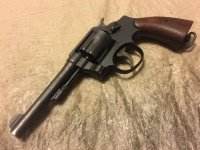
Here is a picture of what your gun looked like when it left the factory in 1943:


attachment.php
 

Attachments

  • FB5D5181-76A2-4089-90FA-F73663F6A214.jpg
    FB5D5181-76A2-4089-90FA-F73663F6A214.jpg
    86.8 KB
Thanks for the additional info. I was only a kid at the time, but I vaguely remember a relative giving my Dad the gun in the late 1950’s, so that jives with the timing you mentioned. I’m guessing the grips are the cheap plastic variety you also mention. Could be had for $30-$35 via Mail Order huh? Wow … those were the days! Clearly not a valuable collectible now, but still lots of fun to shoot.

Just remember, the cheapest Buick Special for 1957 cost $2596 and minimum wage was probably under $1 an hour.
 
When I was a kid and got my first job, I worked in a juke joint as short order cook, soda jerk, etc. One job was cutting a little slit in the cellophane around packs of cigarettes and sliding 2 pennies in. the cigarette machine only took a quarter and cigarettes were 22 cents.
SWCA 892
PS, I was 16 at the time and it was my after school job, it paid a princely sum of 50 cents an hour. When I quit to go to collage my pay was up to 75 cents.
 
When I was a kid and got my first job, I worked in a juke joint as short order cook, soda jerk, etc. One job was cutting a little slit in the cellophane around packs of cigarettes and sliding 2 pennies in. the cigarette machine only took a quarter and cigarettes were 22 cents.
SWCA 892
PS, I was 16 at the time and it was my after school job, it paid a princely sum of 50 cents an hour. When I quit to go to collage my pay was up to 75 cents.

Was that here in Austin? What was the joint? Year? Just curious.
 
No, not Austin, little town (5000 souls) in Pa. When I flunked out of collage I joined the USAF to avoid the draft. Retired in Austin after 20 years, 7 months and 13 days.
SWCA 892
 
It could have been modified by a couple of different companies in England. They did very nice work.

————-
My gun doesn’t have any British “Proof” marks, which I understand is common for these BSR’s. I looked under the barrel and on the cylinder but only found the serial number repeated in both places. Is the serial number all that’s needed to determine if it was a BSR?
 
I don't know how you measured the barrel, but it should be measured from the front of the muzzle, all the way back to the front face of the cylinder.

As to pictures, if you have some, you can send them to me, or someone else, via email, and I will post them on this thread.

Regards, Mike Priwer [email protected]
 
1. Type: Hand Ejector
2. Serial Number: V 288410
3: CTG: 38 S&W
4: Barrel Length: 3 11/16”
5: Sights: Fixed

————-
My gun doesn’t have any British “Proof” marks, which I understand is common for these BSR’s. I looked under the barrel and on the cylinder but only found the serial number repeated in both places. Is the serial number all that’s needed to determine if it was a BSR?

No, the .38 S&W CTG caliber is the determinant (no SPECIAL, which was the US Variant).

In addition, US Victorys were rarely modified post-war like yours, BSR's very commonly. So even if the caliber stamp is no longer readable, our default assumption is that it was a BSR, unless proven otherwise.
 
I don't know how you measured the barrel, but it should be measured from the front of the muzzle, all the way back to the front face of the cylinder.

As to pictures, if you have some, you can send them to me, or someone else, via email, and I will post them on this thread.

Regards, Mike Priwer [email protected]
———-
Thanks! I really appreciate the offer. Pictures are on the way. Go ahead & pick whichever’s useful. I remeasured the barrel the way you instructed & it is in fact 4”, not 3-11/16”.
 
Back
Top