Help Identifing

Joined
Feb 19, 2013
Messages
1
Reaction score
0
Hello,
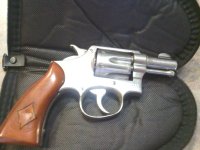
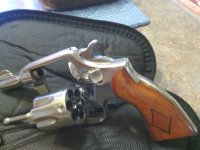
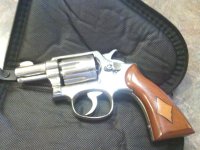
This is my first post to this forum. I recently inherited a S&W from my father-in-law. I have attached pictures of the gun. The S/N is V 2704XX. It has "Made in the USA" and the Smith and Wesson logo on the right side. When you open the cylinder it has and S and 16554 on the yoke. I thought it was a .38 but I am not sure because it isn't marked on the barrel. Any help would be greatly appreciated.
Brian
 

Attachments

  • IMG_20130219_170806.jpg
    IMG_20130219_170806.jpg
    120.5 KB
  • IMG_20130219_170814.jpg
    IMG_20130219_170814.jpg
    111.5 KB
  • IMG_20130219_170901.jpg
    IMG_20130219_170901.jpg
    121.5 KB
Welcome to the Forum.

Your Victory Model has been doctored - and not well. The nickel plate is an aftermarket job. The hammer and trigger were nickel plated as well, which should not be done.

To make matters worse, the barrel has been chopped, eliminating the front locking lug.

This is strictly a shooter. I'm glad you didn't pay good money for this gun. If it is an inheritance, that's fine. Keep it and use it, but the value is essentially nil.

With the front locking lug gone, you'll want to watch it closely. With no front support for the extractor rod and lockup on the cylinder, it could eventually develop problems. You certainly want to shoot only low pressure (low velocity) ammunition in it.

Jack
 
Welcome to the S&W Forum. There will be more knowledgeable folks along pretty soon to give you a more thorough commentary but the brief description of what you likely have is a Victory model British Service Revolver that started out with a 5" barrel and chambered in .38 S&W caliber. The Victory models were made during WWII for U.S. and British Commonwealth countries. The models made for U.S. forces were generally 4" and chambered in 38 S&W Special.

When the British retired these after the war many of them were "refurbished" to include shortened barrels, nickel finish and custom stocks. The short barrel ones like yours were cut so short they eliminated the front locking lug . . . not a good thing. In addition, many were rechambered to accommodate .38 Special . . . also not a good thing. Others can elaborate on all the reasons.

Russ
 
Yes. As Brian stated, this revolver may have been reamed out to accept the .38 Special round. You will want to check that. I forgot to mention that fact in my previous post.
Sorry.
Jack
 
That one would likely date from May-June 1943. As previously stated, it is essentially a postwar-mutilated .38/200 Victory model having minimal monetary value in that condition. A great many of the British .38/200 revolvers met the same fate, and there are huge numbers of them around.
 
On the other hand, It's kind of a neat looking little snubbie. Some of those war-time guns came home in terrible condition. The urge to doctor them up for a few bucks made a lot of sense back then. Hang on to it. It's part of the family tree.
 
Not to say it has no utility. It would probably make a good house or car gun. What happened is, back in the 1950s, British .38/200s were available for almost nothing. As they fired the .38 S&W, they were not too popular on the civilian market. To make them more marketable, the surplus arms dealers went on a binge of chopping barrels, nickel plating, and boring out cylinders to take the much more popular .38 Special cartridges. These modified revolvers sold in the 50s and 60s for $30 or so, and they were advertised widely.

As a historical note, one of these modified S&W .38/200s was allegedly used by Lee Harvey Oswald to kill Dallas police officer J. D. Tippitt after he allegedly assassinated JFK in 1963. And of course these cheap guns were popular among the less-than-lawful back in those days when all you needed to do was have the cash to buy one - no questions asked.
 
Was just curious, but can anyone tell me what is under the thumb latch?

It looks like the Hammer stud was replaced post refinishing. I never saw that before. It may just be the lighting but any info from the more knowledgable would be appreciated.
 
. . . It looks like the Hammer stud was replaced post refinishing. I never saw that before. . . .

Actually, the refinishing did not disturb the hammer stud mount as is typically found after excessive buffing on the frame.

Prior to and during WWII, what you see was the rivet-like method of mounting the hammer stud. Very soon after WWII, the method was changed to a threaded stud and was polished flat.

Victory020.jpg


Russ
 
Last edited:
Back
Top