How to fix case problem

drthunder

Member
Joined
Sep 29, 2012
Messages
11
Reaction score
1
City & State/Province
Georgia
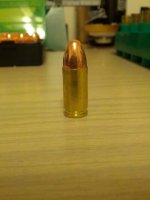
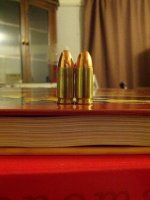
So I just got my full setup for reloading for christmas. I ran my first batch of handloads and noticed a problem. My cases have a dip in them behind the bullet. I am using RCBS reloading dies and am wondering if it's my bullet seating/crimp die or my resizing die causing the problem. I need some help figuring out how to fix this and also wondering if the current ones I have are safe to shoot. Thanks in advance.
 

Attachments

  • IMG_20121230_202317.jpg
    IMG_20121230_202317.jpg
    31.7 KB
  • IMG_20121227_184602.jpg
    IMG_20121227_184602.jpg
    45.2 KB
It's not unusual to have a slight dip, as you call it behind the bullet.
This is due to the resizing and belling steps which reduce case diameter. Belling prepares the case for the bullet slightly expanding the case. It appears that you may not have removed all of the bell from the case mouth.

Remove the barrel from your gun and check to see if the reloaded round drops freely into the chamber. The base should be even with the barrel hood.

More load information would help us determine if your load is safe.

Bruce

As you will learn not all cases are the same thickness. Remington seems to be the thinnest and you would probably see no bulge. Winchesters always seem thicker and may show the bullet base in the case.
 
Last edited:
Sounds like a good plinking load to me.

If you think the cases look bulged now wait until you load them about five times.
The 9 mm can get down right ugly looking with a pronounced ring around the base from resizing the brass.

Bruce
 
Bruce Lee is correct in what he says. My .45 Colt handloads in multi-used brass bulge more than what I see in your photos.
 
This bulging it more pronounced with the 9mm due to it being a tapered case. The carbide ring sizes the case mouth small enough to have enough tension on the bullet. This sizing is then a little excessive on the lower part of the case. But it works just fine and is normal. Some folks say they only size to the bottom of the bullet to keep the over sizing from being visually distracting.
 
drthunder,

Bruce Lee is absolutely correct. Sizing dies have to reduce the thinnest cases enough to achieve adequate neck tension. 9mm cases vary more between brands, including military, than any other ammunition. The result is over sizing of the heavier cases. When they are expanded the result is a distinct "Coke Bottle" shape as you are seeing. There isn't anything to do to "fix" this except use the thinnest brass you can get, which is usually R-P. S&B and military are the thickest typically.

In other words, don't worry about it, it is only cosmetic.
 
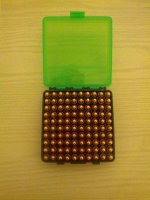
Thanks everyone for the info. You have reassured an amateur reloader. Now I can't wait to try my first run.
 

Attachments

  • IMG_20121230_230553.jpg
    IMG_20121230_230553.jpg
    51.4 KB
Did you do the drop and plunk test? Remove the barrel, drop a round in and it should plunk in. Turn barrel over it should fall right out. If so, you are good to go.:) This is a 1911, but give you the idea.

This pic is often used to help explain correct headspacing and how O.A.L. can affect chambering and headspace.

attachment.php
 
Thanks everyone for the info. You have reassured an amateur reloader. Now I can't wait to try my first run.

I remember pulling the trigger on my first reloads - it's a moment few forget.

Enjoy! :cool:
 
"I remember pulling the trigger on my first reloads - it's a moment few forget."

Been reloading rifle shells a long time, just bought my first pistol year ago, first pistol reload I think I turned my head and closed my eyes !!
 
"I remember pulling the trigger on my first reloads - it's a moment few forget."

Been reloading rifle shells a long time, just bought my first pistol year ago, first pistol reload I think I turned my head and closed my eyes !!

Sounds about right! I had visions of blowing my arm off, taking out the back wall, all sorts of calamities...:D
 
Most reloaders set up the reloader ram at full hight to where it just tuches the resizing die when screwed down into the unit.
If you are using new brass and shooting target loads you can have 1/8-1/4" of a gap above the ram, to not "Overwork" the brass and still have a firm bullet grip for FMJ bullets in a 9mm Luger.
A minimum bell to start the bullet will also make the brass last longer..........as a light crimp,since the 9mm works off of the front end of the case for correct seating depth.

My 9mm with the Sierra 115gr ball oal 1.125" with 5.8grs of Unique was the most accurate load for me with 4.5grs of Bullseye coming in at 2nd place. These are NOT +P loads.
 
Last edited:
Back
Top