Knife sharpening

F4phantom

US Veteran
Joined
Sep 29, 2020
Messages
633
Reaction score
2,576
City & State/Province
Just Southeast of Cleveland, Ohio
I just finished the knife thread and found it interesting. I have several old (circa 1980's) Gerber knives and a couple of inexpensive knifes that need to be sharpened. I have tried a couple of whetstones but I find that I cannot keep a good angle. Has anyone worked with a fixed angle sharpener and if so which one? I have been looking a WorkSharp but maybe a Lansky fixed angle. What do you all use.
 
I bought one of these. You could probably shave with my kitchen knives.

i-rJC6H5k-L.jpg


I bought one of these on Black Friday last year. I'm not good at sharpening knives, like the OP my problem is holding a consistent angle.

The sharpener is essentially a jig that holds your knife at a consistent repeatable angle.

I can turn any KNIFE into a razor in about 20 minutes with this sharpener
 
Last edited:
F4phantom,
I have the "Work Sharp" outfit, carries in my pocket, it has the coarse, fine and ceramic plus the leather all contained together. The diamond impregnated plates are held by magnets and are replacable. All by hand with just angled guides on each end to help with the proper angle. It is a learned action and you will be glad you did.

I will add that using a motorized sharpner does offer the possibility of overheating the blade edge and I have never used one since I was a youngster and rouined so many knives because the stome was too coarse or I applied too much pressure.

I can sharpen a knife but am unable to post pictures.
 
Last edited:
Several years ago (maybe 10-12?) I bought the Work Sharp for our kitchen knives. It's done an impressive job and I do recommend it, but only for kitchen knives..
I also have the Lansky system and it works well. For medium to larger knives (kitchen/butchering), this is my "go-to" to get them
Having said all that, I use my hand-me-down-to-me from my grandfather to my father to me oil and whetstones for my pocket and hunting knives.

WYT-P
Skyhunter
 
While I am by no means a master, I can make a serviceable edge with a whetstone. It’s a skill every man should have. So recognizing my frailties, I bought a Lansky sharpener many years ago. The Lansky made wicked sharp edges, but was a bit of a pain for long kitchen knives. So I bought a Chef’s Choice 120 which I now use on all knives. Purists will cry out in anguish at the thought. Not many of them can make a better edge.
 
I have a Smith's , which is like a Lansky . Speaking of , I was given one but I've never used it . Years ago I started a post about honing blades . I posted I know it's sharp when I can shave the hairs on my arm , which my dad did . I caught some s*** about it , but it was good enough for my dad and my older brother . Another member that lives/ed near me pm'ed me and gave me a little jig that holds your knife at a perfect angle and I can use my Arkansas stones .
 
F4phantom,
I have the "Work Sharp" outfit, carries in my pocket, it has the coarse, fine and ceramic plus the leather all contained together. The diamond impregnated plates are held by magnets and are replacable. All by hand with just angled guides on each end to help with the proper angle. It is a learned action and you will be glad you did.

I will add that using a motorized sharpner does offer the possibility of overheating the blade edge and I have never used one since I was a youngster and rouined so many knives because the stome was too coarse or I applied too much pressure.

I can sharpen a knife but am unable to post pictures.
I have this sharpener, too, the Worksharp Guided Field Sharpener. In fact, I have two of them. Lost one, bought a replacement, and within a day or two the old one turned up, as I expected. I can get just about an y knife of mine to shave arm hair and cut paper cleanly. I’m not splitting any whiskers, and I am not interested in doing that.
It is a little big for pocket carry, but I throw one of them in a bag when I travel. I have the worksharp power sharpener, too, Ken Onion model. It worked pretty well for me but the housing broke and the company does not have a replacement part. Since I was outside their one year warranty period, the won’t replace it. I haven’t pursued it, in part because the Field Sharpener meets my needs.
 
If you are frugal like me and want to do a bang-up job with just a stone I suggest you learn this guys technique. It is the only method I've ever used with a stone that worked for me. I can get knives shaving sharp with just a $3 Harbor Freight stone. I use the ones they sell as a whetstone. Works for me.

Edit: I Could not link the video, but if you go to Youtube and type this in it will take you there. I am really happy I came across this technique.

How to Sharpen a Knife with a Japanese Master Sharpener​

 
Last edited:
Mostly I use a 400grit belt on one of my 2x72 belt grinders and run it as a slack belt. Then go to my buffer with fine rouge to polish to a final edge. BUT, I can do it by hand and when I do I use first a course then a medium fine diamond, then a fine if I am looking for a fine edge. But, you can get a perfectly serviceable edge with a medium fine. I will never waste my time and money on another stone. Holding the right angle just takes practice

IF you use straight high carbon steel blades you can get a wicked sharp edge, I can get shave you hair sharp from most decent steels, but NONE of them will keep an extra keen edge with normal use. Some will keep paper cutting sharp with fairly heavy use.
 
I bought a Work Sharp Onion edition a few years ago but could never get a decent edge on anything. For me, it's too hard to hold a consistent angle against the belt, even though there are guides for both sides.
I currently use a Sharpal 162N Double-sided Diamond Sharpening Stone Whetstone Knife Sharpener Coarse 325 / Extra Fine 1200 Grit, Angle Guide (8 in. x 3 in.)
I have never had sharper knives. They are about $70 on Amazon but are worth it.
OUTDOORS55 has a lot of videos on how to use it properly. One of the best is titled "Sharpening a Kitchen Knife In Real Time".
 
I bought one of these. You could probably shave with my kitchen knives.

i-rJC6H5k-L.jpg
I have one of those also and love it. My only issue is being carful not to remove the point on the knife. I believe it actually mentions something in the manual
 
I forge knives, parangs, bolos, garden tools, hammers, etc. See my post from a while ago in the knife section.
For speed a 48" belt grinder and a buffing wheel. No, you do not have to burn the edge...
For touchup a common steel, the best I've found are old ones like those made by Landers Frary & Clark, etc. The kind that used to come with a carving set.
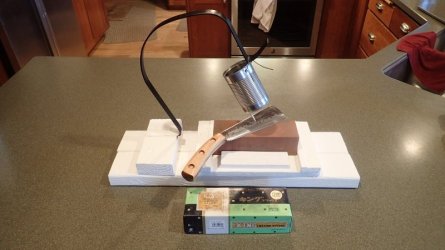
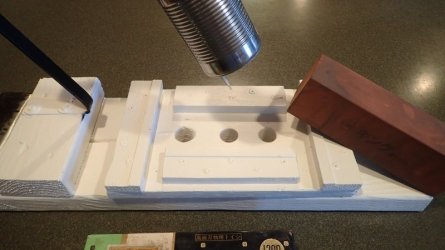
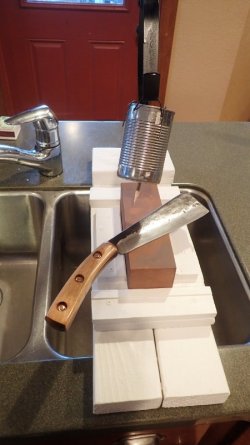
For kitchen knives & others a setup I use with Jap waterstones as pictured below. Mounts over the sink. Water drips constantly from the can
 

Attachments

  • knife.sharpener.fixture.king.whetstone.water.02042024 008 (800x450) (1).jpg
    knife.sharpener.fixture.king.whetstone.water.02042024 008 (800x450) (1).jpg
    67.6 KB
  • knife.sharpener.fixture.king.whetstone.water.02042024 008 (800x450) (3).jpg
    knife.sharpener.fixture.king.whetstone.water.02042024 008 (800x450) (3).jpg
    63.1 KB
  • knife.sharpener.fixture.king.whetstone.water.02042024 008 (800x450) (5).jpg
    knife.sharpener.fixture.king.whetstone.water.02042024 008 (800x450) (5).jpg
    59.9 KB
40 + years a meatcutter. Always used a Norton 3-stone setup. Don't think I ever used the course stone ceptin for some kitchen knives my wife abused...HA! I found the best way for me to get the right blade to stone angle was to lay the blade across the stone. push down on the edge, and try to keep that angle.
 
I have a large knife collection. Some are collectors (mint pre-1990 Case folders) some more modern (Emerson. Benchmade, Spyderco, Cold Steel, Busse, Kellam, Ahti, Marttiini, Roselli). Blade shape sort of determines the optimal sharpening method. However for a beginner I would avoid anyththat is powered. It is too easy to do too much and do more harm than good. A cheap but very good sharpening system is the lowly crock sticks. A wood block with 2 or 4 angled holes and 2 or 4 round ceramic rods. You only need to hold the knife with the blade vertical and let just the edge slide down the rod while moving down and back at the same time. Sounds complicated but it is simple. YouTube has videos. A set of crock stick is cheap and very effective. Just make sure the rods are generally straight and have no defects. In general the grey rids are rougher and the white ones are smoother. I will use a little bit of adhesive paper label to make sure the kids if snug in the base. As metal builds up on the rod rotate it a slight amount. The rods can be cleaned with stove top cleaner and rinsed under water. Ebay can be a good source for some crock sticks (under $20). The longer ones are easier to use. Good luck.
 
I have several old (circa 1980's) Gerber knives..........
Made me smile.

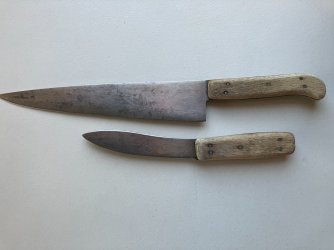
I use these in the kitchen everyday.IMG_1070.JPGIMG_1071a.JPG


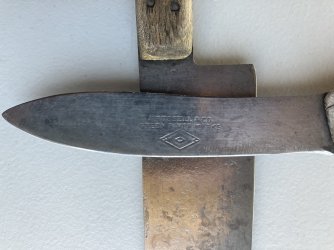
As near as I can tell the skinner was made prior to about 1875 because that's when J. Russsell/Green River Works changed from a stamped logo to one acid etched. The kitchen knife is not marked but shows the same handle materials, rivets and age.

They were discovered together when an old pioneer house was being demolished in northern rural Nevada.
 
Last edited:
I have been using the Lansky system for about 40 years. They will replace any damaged stones and actually sent me a new box when I told them the original red one warped over time.
I have used and own a number of stones, but I rely on the Lansky for my kitchen knives.
I machined my own 'stand' to place in my vice so I don't have to hang on to the knife/clamp assembly during sharpening. Works nicely as it pivots when needed for blade lengths.
I transitioned my original stone system to add some diamond cutters. Medium and fine only. The original course stones cut some of the work in half when needed.

bdGreen


Porcelain plates and metal pans are real edge destroyers. Bone and coarse hair ain't the best on them either.

My wife and step daughters can wreck an edge quick. I have an old carbon steel butcher knife in the rack I use a lot. It stays sharp because it is ugly and they don't use it. LOL
 
The most important thing I learned about sharpening is to sharpen one side until a burr forms along the edge, then switch to the other side and sharpen until you get a burr. At that point the two sides have come together in the sharpest edge possible. Then strop off the burr.

Another thing that helped me was to use coarser stones to start with. If I start with too fine a grit I get frustrated or bored and start varying the angle. Unless the blade is pretty sharp to begin with, I start with a diamond stone, then progress to medium and fine.

I use a Spyderco Sharpmaker with the diamond rods. The only angle you need to maintain is 90 degrees, which is easy to recognize and keep. After I get a burr with the coarse rods I use the medium until I get a burr and then usually go to the fine rods and get a burr. Then strop off the burr.

For cutting meat and other fibrous material like rope, a medium grit cuts better than a fine grit. For carving wood, use a fine grain to finish.
 
I have been sharpening knives ever since I was about 10 years old. In the beginning I took a dull knife and made it even duller using a silicone carbide stone - or similar! lol! After I got married 46 years ago I bought a Lansky (or similar) system. Years later I bought the KME system which IMHO is way better, gave me great results but took way too long for each knife and replacement stones are costly. I then bought the Spyderco system and while it works well, it is basically only good for slightly dull knives. Start with a really dull knife and you will be there all day long! Along the way, (about 38 years ago) I purchased a really good set of 3 Arkansas Stones. Again, they can give great results if you have the muscle memory to hold a consistent angle, but take a while if doing multiple knives. They are also a bit more messy as I used them with honing oil.

A few years ago I decided to get serious about sharpening and I needed a method to sharpen knives fast and at the same time be able to make them razor sharp if I want to (depending on what knife I am sharpening). At the urging of StrawHat here on the forum, I bought a bunch of larger diamond stones (3" x 8" and 3" x 10") in different grits. Since buying them I have done many hundreds of knives, scissors, chisels, etc and they are IMO the absolute best way to go. The diamond stones last a very long time too! Someone doing sharpening just on their own personal knives will probably get decades out of quality diamond stones. A 325 - 350 grit and a 1200 grit are the two (course an fine) stones I'd get. Finishing the process with a good leather strop and that is all you will need IMO.

Learning to hold a consistent angle is way more important that the actual degree of angle you sharpen to. Anywheres around 15º-20º is good and 17º is what I sort of shoot for but never really check. For fine cutting knives I will lean towards the 15º and for your average knife about 17-18º. If the knife is a shop knife subject to rough work, I will even increase the angle a bit more to 22º - 25º, but again, I no longer measure the exact angle - I just go by feel now. The key is develop muscle memory to hold the angle consistent. There is no magic bullet other than to keep practicing, use your thumb and forefinger as an angle guide, and use a magnifying lens to make sure you are getting one consistent angle instead of many different facets.

I can usually sharpen a dull kitchen knife in about 7-10 minutes (including stropping). One that has been really abused and neglected and needs re-profiling obviously will take me longer - about 15 minutes. I know many can do it faster, but probably not better. When I sharpen a knife, I sharpen it to what it will be used for.

I know some buy the Worksharp products (a bit pricey to buy and get belts and parts for) but I personally do not like using a glorified motorized belt sander on fine knives. Sometimes I will use a belt sander to rough profile a knife that is in really poor shape and needs to be thinned a little. I then finish by hand on the diamond stones. Yes it can be quicker but most who use them exclusively more than likely cut the longevity of the knife down by removing too much metal each time it gets sharpened. On my own personal knives I never let them get really dull and I can put a razor sharp edge back on them in 30 - 45 seconds just with the diamond stone. A few licks on the strop and the sharpened knife is back in the block in a minute. Hand sharpening is a developed skill that many can do if they are determined. Some just want the easy way out. Whatever method or sharpening system you use needs to satisfy your needs, skill level, pocketbook and patience level. BTW, a diamond stone needs no real maintenance, requires no electricity, oil or water so it can be used anywhere.
 
Back
Top