Lanyard Loop

Joined
Jul 9, 2010
Messages
5,039
Reaction score
8,703
City & State/Province
Spokantucky
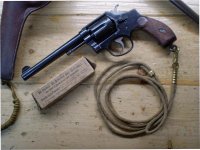
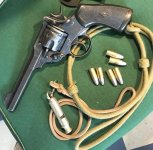
I've always assumed that the lanyard was worn around the neck and clipped to the lanyard loop on the beloved M1917 and of course others including the 1911. I have recently seen a leather military swivel holster, designed for cavalry use with a curious brass eyelet. At the time the 1917 was issued there were no airborne troops, the cavalry would be the group most liable to loose a pistol in combat and therefore makes sense to use a lanyard. It also makes sense to me that the proper use of the lanyard would be to push the doubled end through the lanyard loop, push the snap end through then snug up the lanyard, after which snap the end with the fixture onto the eyelet on the holster. That makes a hell of a lot more sense than looping it over your neck which to me creates as much trouble as wearing long hair and earrings in a bar room brawl. Any enlightenment would be appreciated.
 
I have never seen a photograph that did not use the snap to attach a revolver. I would think that it would be quite easy to remove a gun from the lanyard using the clip, but time consuming removing the lanyard using your method. I did quite a bit of research when I acquired a US Army Model 1899. What I found was a all reenactors, using the clip.

If you wear one around your neck, the lanyard is at maximum distance it can go at a full arms length one handed revolver hold, so any looping will not allow you to properly aim the gun. There is also a brass cinch about half way down the lanyard that would not easily allow you to loop it.

attachment.php
 

Attachments

  • P1010009.jpg
    P1010009.jpg
    107.9 KB
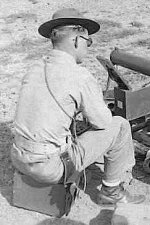
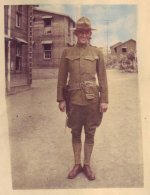
They were not usually worn around the neck by US troops. They are usually worn on one shoulder under the epaulette-


attachment.php


It can also be worn around the neck and one arm-


attachment.php


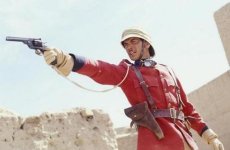
Even when worn around the neck, like Mounties in their red dress, they have it under both epaulettes.


Even if worn around my neck, and you are using both hands to choke me, I'll be using MY hands to do mean things to you, like shoot you, stick you, claw both your eyes out, box both your ears, knee you in the groin, etc, etc. ;)
 

Attachments

  • lanyard.jpg
    lanyard.jpg
    18.8 KB
  • Lanyard 1.jpg
    Lanyard 1.jpg
    18.5 KB
Using the 'snap" on the ring caused wear that is not normally seen!

In a recent thread about proper accessories for the Webley/Enfield pistols, no snap at all just loop it through on the gun, then on the web gear.

I use a lanyard on my 1917 Brazilian, It is homemade and over one shoulder and looped through the ring, no snap to cause wear or make extra noise. On my Contenders and scoped 29 Classic, I use 1" web and rifle sling stud and ring. Don't want to drop anything from a tree stand.

Ivan
 
Good discussion on lanyards and loops. Just as a side, any pics of the factory lanyard for the S&W mod. 39/59? Just wondering.

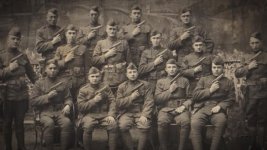
Here is the odd thing, I was online searching for any historical WWII or prior images of a soldier, UK or US, wearing a lanyard and could not find one picture that showed the cord!!! I could find lots of soldiers wearing a holstered revolver or pistol, but none with a lanyard attached???

attachment.php

attachment.php
 

Attachments

  • artv_1.jpg
    artv_1.jpg
    64.7 KB
  • post-70-1274308434.jpg
    post-70-1274308434.jpg
    49.2 KB
Lanyards do not appear to be absolutely mandated back in WWI or 2. But often they would be attached to the shoulder strap of web gear. Not around the neck. When I deployed to Iraq and Afghanistan they mandated that all pistols be secured with a lanyard. I used the telephone cord version ( still have mine kicking around somewhere) and it was threaded through the beretta lanyard loop ( mine has gutted parachute cord) and a belt loop with a snap was then attached to the belt. The stretchy character of the telephone cord made it relatively snag free, compared to the long issue GI lanyard
 
There's a section on lanyards on the USMilitaria forum.

I'm never sure which sections seem to need membership and which ones don't.

post-56-1197682486.jpg
Thread is "WWII pistol lanyards"

Photo described as either USN or USMC flyers WW2 by poster 'Dustin'.
 
Last edited:
I was taught to avoid having ropes and cords around my neck. Over my neck and under a shoulder would be OK, but attached to belt would be better.

I have seen photos of men shooting using the neck/shoulder method and with lanyard taunt.
 
In the late 80's the Ohio National Guard had 4 lanyards on the TO&E for each company (didn't matter what kind of company). The units were losing a lot of small equipment during annual training. There was a Big pow-wow of ALL AGR supply personnel. The 2 Star was honest input on why that were loosing equipment. An E-2 from a small town unit spoke up and said. "There are only 4 lanyards per company, they are not listed as expendable, and if I don't account for them, I get written up." Shortly thereafter, cases of lanyards were taken from some "Secret Stash of Strategic Stuff", and two cases of 100 were issued to each company. They were reclassified as expendable, and the State was out $.79 for each man. My best friend was a supply sergeant in artillery, and my F-I-L was the CSM for the 11th Engineers and they were talking at one of my cookouts, about ridiculous non-expendables, including ball point pens! To which my F-I-L replied, until we change that use a lanyard!

The lanyards the ONG had at first used white metal (aluminum?) like German surplus. But the blackened brass showed up about 9 months later. At that time the white metal lanyards turned up a flea markets in the thousands!

Ivan
 
Thanks fellers...Got more interest that I was expecting. I did a little study and found that early on for the most part although the lanyard loop was installed on pistols, revolvers and yes even some magazines the lanyard was not an issue item in most cases. I could see a definite need for mounted troops in much the same way as loops were installed on early rifles like the Springfield and Sharps carbines. I'm sure many troops would toss them away unless under threat of direct discipline, officers would probably have looked the other way regardless. Mainly out of curiosity that I checked in with the bunch of you and found some very interesting comments, thanks for enlightening me. From a personal point of view, I've never worn a lanyard nor have I ever had an interest in doing so. I can however see a definite advantage to using one particularly mounted, airborne, sea service personnel, etc. where dropping a handgun is tantamount to the disaster of being unarmed. I may do a bit of further experimenting to see what shakes up, part of the reason so many original lanyards are available is probably due to the fact they were manufactured in quantity but never issued as intended for all of the many various reasons we have discussed.
On a side note I spend most of my time shooting muzzle loading firearms. I have a good buddy I shoot with usually three days a week. He has always worn his shooting bag and all of its many accoutrements. He walks by and has more stuff dangling off him and on occasion snags something or the other ripping it off, leaving it behind. At least once a year he fails to plug his powder horn or the plug falls out and leaves a pile of powder where he sat. We threaten to toss matches at him the next time it happens. One of his items is a vent pick (used to poke the touchhole on a flintlock) he fashioned using a turkey foot as a handle. One day I found the turkey foot on the floor of the range and stuck it in my pocket, later I asked him if he was missing anything, he looked down and swung himself to bring all of his gear around to see, I handed him his turkey foot and said "Your molting." Thats was buddies are for...
 
I've always assumed that the lanyard was worn around the neck and clipped to the lanyard loop on the beloved M1917 and of course others including the 1911. I have recently seen a leather military swivel holster, designed for cavalry use with a curious brass eyelet. At the time the 1917 was issued there were no airborne troops, the cavalry would be the group most liable to loose a pistol in combat and therefore makes sense to use a lanyard. It also makes sense to me that the proper use of the lanyard would be to push the doubled end through the lanyard loop, push the snap end through then snug up the lanyard, after which snap the end with the fixture onto the eyelet on the holster. That makes a hell of a lot more sense than looping it over your neck which to me creates as much trouble as wearing long hair and earrings in a bar room brawl. Any enlightenment would be appreciated.

If the eyelet is the one at the bottom of the holster it’s for a leg tie down. Snapping the lanyard to it would keep the gun connected to you but it would drag on the ground if dropped when on foot or horseback and slow to retrieve! Not to mention entangling on everything when the gun is holstered!
 
The snap is part brass but the spring part is spring steel on mine. But regardless, when connected to the lanyard swivel on the gun, in normal use it reeks havoc on the finish and the stocks as posted above.

But looping the lanyard thru the swivel, and making a loop as Kinman suggests, then make a head and shoulder loop with the snap tying a knot to limit the snap travel works very well. Easier to get on and off over the head and arm as well.
 
The snap is part brass but the spring part is spring steel on mine. But regardless, when connected to the lanyard swivel on the gun, in normal use it reeks havoc on the finish and the stocks as posted above . . .

I think some are placing way too much emphasis on how a lanyard clip affects the condition of the revolver. First, weapons used in the armed forces are not owned by the soldier. While they maintained the mechanics of the guns issued because their function could mean the difference between life and death, they cared little about scratching or affecting the finish. Most soldiers were given rifles and handguns that had already seen a fair amount of use and abuse by prior soldiers. They did not own the guns, they could turn them in for a replacements as needed, and had to turn them in when their tour were over. Heck, I carried a M1911 for awhile that dated to WWII and shooting it at targets often showed holes that looked like wadcutters, but I knew it was just the bullet tumbling and hitting the target backwards. That was unusual because most of the time it was key-holing. Finish was half gone, stocks were beat up, rifling was obviously barely there, but I kept it functioning flawlessly.

It seems that few early 1900s soldiers used lanyards anyway since only a few images showing lanyards can be found. My Army days were quite some time ago in an era of some country conflict that started with a V and times may have changed, but imagine soldiers still pay meticulous attention to the mechanics of their weapons, but cared little about their aesthetics.
 
The Brits used them on whistles too. In A Bridge Too Far the German officer refers to their use of a horn prior to a charge on the bridge as ‘fools courage.’ I would think the same would apply to a whistle.
 

Attachments

  • 708851ED-E8F6-41F8-9A5B-95188B7C5CBD.jpg
    708851ED-E8F6-41F8-9A5B-95188B7C5CBD.jpg
    123.4 KB
Last edited:
Gary, that’s all true of course. Function is the bottom line for any gun especially in armed conflict. You only have to see one gun that was used with the GI lanyard to see the superficial damage. Not unlike the proverbial ‘butterfly’ pattern on Winchester lever action rifles from the saddle ring.

Which means a lanyard for a collection gun would be strictly for display.
 
Thanks fellers...I could see a definite need for mounted troops in much the same way as loops were installed on early rifles like the Springfield and Sharps carbines....

Had a Wnchester Wrangler that had what they called a "Saddle Ring" pretty neat and my guess was an option to insure the rifle didn't bounce out of the saddle holster.

Was an ocean lifeguard in my youth and always kept my whistle and car keys on a bright lanyard because if you dropped them in the soft sand they were otherwise gone where the lanyard was a good visual of where they were.

Years later on the FD dive team I rigged my dive gear with plastic quick release buckles and lanyards on my essentials like wire cutters, flashlight etc as sometime you'd need both hands in a hurry and simply dropping the tool meant it could quickly be recovered.
 
Last edited:
Engine49guy;141703628[B said:
]Had a Wnchester Wrangler that had what they called a "Saddle Ring" pretty neat and my guess was an option to insure the rifle didn't bounce out of the saddle holster.[/B]

Was an ocean lifeguard in my youth and always kept my whistle and car keys on a bright lanyard because if you dropped them in the soft sand they were otherwise gone where the lanyard was a good visual of where they were.

Years later on the FD dive team I rigged my dive gear with plastic quick release buckles and lanyards on my essentials like wire cutters, flashlight etc as sometime you'd need both hands in a hurry and simply dropping the tool meant it could quickly be recovered.

"I could see a definite need for mounted troops in much the same way as loops were installed on early rifles like the Springfield and Sharps carbines."

In theory, one tied a leather thong to the Winchester's saddle ring and then hung it over the saddle horn. My guess is that most mounted men used a scabbard or simply carried the carbine in ones' hand, with the forend resting over the saddle.

Cavalrymen wore a wide leather sling over one shoulder and this sling had a large snap that went through the saddle ring. The muzzle of the carbine went into a leather socket attached to the rigging of the saddle.
 

Latest posts

Back
Top