The .45 ambi lever is needed on the decock-only, spring-loaded assemblies for the 9/.40 guns. It has the added "spacer" material to help keep the decocker body from shifting to the left and possibly causing interference between the firing pin and the inside cuts of the decocking body.

Now, to your original question OP ....
If you remove the manual safety body spring and plunger (simply called the body plunger, BTW) from the manual safety body, you're going to cause some really annoying problems for yourself.

In the armorer classes they usually made
very sure that armorers payed attention to
never mistakenly mix up the
light tension ambi lever spring for the HEAVY tension body plunger spring.
The reason is that the heavy body plunger spring's tension is needed to keep the manual safety assembly from rotating downward as the slide slams against the rear of its travel.
The symptom if this mistake has been made? The gun typically "decocks" itself after each shot, by itself, with the manual safety lever(s) remaining in the down/on-safe position after the slide has gone back forward.
You have essentially created a single shot pistol that can decock itself and remain on-safe.

(The recoil force running the slide to the
rear is more forceful than the spring-driven force pushing the slide back forward, and then you have the forward force further reduced by the slide stripping and feeding a round from the magazine, under the extractor, up the breech face and then pushing the barrel back into battery with the slide.)
You might chuckle at imagining this happen, but having a 3rd gen decock itself and remain on-safe tends to really hamper getting off subsequent shots quickly. It also chews up a few moments to realize what's happened.
I knew an agency where this problem happened when a newly minted armorer was allowed to strip some duty weapons, and the head armorer wasn't available at the time to keep an eye on things. The armorer mixed up the springs. This was discovered at the next range qualification, when the guns started decocking themselves and remaining on-safe ... a few months after everyone had been carrying them on-duty without knowing what had unwittingly been done to them.
There's a reason the armorer classes used to really emphasize not making that mistake with the plunger springs, or being "that guy".
Now, the flip side is that trying to installed the HEAVY body plunger spring under the ambi lever takes some real effort, which is a hint. I once had one of our less experienced armorers come get me to come to the bench. He told me he couldn't figure out why the ambi lever spring was so hard to compress to reinstall the ambi lever. Yep, he was trying to push the body spring into the ambi lever hole ... which meant he'd already put the really light ambi lever spring under the body plunger. Imagine if he'd not have come to get me to look at it, and the gun had gone back into service after he'd managed to shove the ambi lever over the wrong spring.
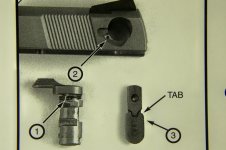
This is the body plunger (left) and ambi plunger, and their springs. (This is the revised ambi plunger, with the straight walled body. The original one looked a lot like the body plunger, except it had a flat tip on the head. See next/second pic below.)

Revised ambi plunger (top); older ambi plunger (middle); body plunger (bottom).