
You are using an out of date browser. It may not display this or other websites correctly.
You should upgrade or use an alternative browser.
You should upgrade or use an alternative browser.
Modifying a Model 645?
- Thread starter HarryH
- Start date



Yes it is. I had one back when I carried a duty revolver and did not want anything to do with the S/A and decocker. Foolish since I didn't carry it or even shoot it much. My gunsmith placed at least one if not two pins or screws in the action but I don't remember where. I watched him do it and it didn't take much work. He drilled the holes for the pins but don't recall for sure if he threaded them but I think he did. The gun functioned flawlessly but I couldn't deal with that trigger pull compared to a revolver.
JohnHL
Member
- Joined
- Aug 6, 2013
- Messages
- 3,865
- Reaction score
- 6,437
- City & State/Province
- Foothills of the Ozarks
Yes. Quite easily, Harry.Is it possible to modify a Model 645 to fire double action ONLY, without it becoming full auto?
Simply grind away the single action notch on your hammer.
Presto, double action only.
If you do not want to modify your original hammer, practically any S&W DA/SA hammer from any 2nd or 3rd gen S&W pistol will work.
John
Sounds like a great idea, except that I have never taken apart the action on it and I would be very nervous about putting it back together.Yes. Quite easily, Harry.
Simply grind away the single action notch on your hammer.
Presto, double action only.
If you do not want to modify your original hammer, practically any S&W DA/SA hammer from any 2nd or 3rd gen S&W pistol will work.
John
JohnHL
Member
- Joined
- Aug 6, 2013
- Messages
- 3,865
- Reaction score
- 6,437
- City & State/Province
- Foothills of the Ozarks
It IS a great idea, Harry!Sounds like a great idea, except that I have never taken apart the action on it and I would be very nervous about putting it back together.
(But it is not my idea.)
It is SO great that S&W used it to build the 3914DAO.
If you are too nervous to work on your own gun, take some time to study some disassembly videos: https://smith-wessonforum.com/threads/s-w-3rd-gen-complete-disassembly-video.312127/
If you are still unwilling to undertake the task, then simply decock the hammer after each shot.
John

BMCM
US Veteran
None of the above. Those hammers are unique to the XX26 frame decocker guns and have two more notched over the regular TDA hammers. You want a three notch hammer like is in your gun now. B=fullcock notch, C=pickup notch, D-throw notch
Rather than ruin a serviceable original part, swap in a factory DAO hammer assembly.
https://jackfirstinc.com/product/sw...y-stainless-models-4043-4046-4054-1040-20279/
Also note the DAO guns use a different trigger assembly so...
https://jackfirstinc.com/product/sw-1000s-trigger-double-action-only-304-wide-pad-1040-26221/
Also, remove the rear release lever and install this spacer in it's place...
https://jackfirstinc.com/product/sw...-spacer-double-action-only-models-1040-23388/
Since the manual safety body no longer has a function, it can be removed.
To fill the hole a factory firing pin retainer may be fitted.
https://www.gunpartscorp.com/products/347300
Or you could sell the thing and go find a 4546.
Cheers
Bill
Rather than ruin a serviceable original part, swap in a factory DAO hammer assembly.
https://jackfirstinc.com/product/sw...y-stainless-models-4043-4046-4054-1040-20279/
Also note the DAO guns use a different trigger assembly so...
https://jackfirstinc.com/product/sw-1000s-trigger-double-action-only-304-wide-pad-1040-26221/
Also, remove the rear release lever and install this spacer in it's place...
https://jackfirstinc.com/product/sw...-spacer-double-action-only-models-1040-23388/
Since the manual safety body no longer has a function, it can be removed.
To fill the hole a factory firing pin retainer may be fitted.
https://www.gunpartscorp.com/products/347300
Or you could sell the thing and go find a 4546.
Cheers
Bill
JohnHL
Member
- Joined
- Aug 6, 2013
- Messages
- 3,865
- Reaction score
- 6,437
- City & State/Province
- Foothills of the Ozarks
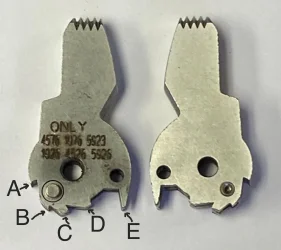
Hi, Harry!Hi, Please check out the attached photo and advise which is the single action notch. Thanks.
Bill is correct that the hammer you have chosen as an illustration is indeed for a somewhat different action style than that which you possess, so I would not modify one of those hammers for your purpose.
The correct 2nd or 3rd gen "TDA" (DA/SA) hammer would be preferable.
They are also the most common and therefore, the least expensive.
For the purpose of illustration, the hammer you have pictured does have notches which correspond to the notches on the TDA (which is the S&W abbreviation for Traditional Double Action which means Double Action/Single Action, like yours) hammer.
In your illustration, "A" is the "half cock" or safety notch.
This notch is there to arrest the hammer should it unintentionally fall.
This notch is present on 2nd gen hammers, but was removed from 3rd gen hammers because the firing pin safety rendered them redundant and owner's justifiably complained that they caused a "hitch" in the double action trigger pull.
If the hammer you choose to modify has this notch you should leave it.
Notch "B" is the Single Action notch and is the notch to grind/file away to convert to "DAO" (Double Action Only).
Notches "C" and "D" are double Action notches and should be left alone.
Notch "E" is not an action notch for these purposes and can be ignored.
The simple expedient of removing notch "B" will convert your 645 to double action only with no single action.
Obviously, reinstalling your original hammer will return your pistol to its original configuration.
The conversion to which Bill is alluding is what I call "S&W Single Strike Double Action" and is what S&W used on the majority of their DAO offerings.
There are pros and cons to that conversion.
The pro of that conversion is a shorter trigger pull.
The cons of that conversion are higher complication, more "fitting", higher expense, and "Single Strike" limitation (i.e. the hammer will fall when the trigger is pulled, but the slide must be cycled for the hammer to fall again).
The modified hammer version of DAO wherein the single action notch is removed is much simpler and leaves the gun as "Second Strike" capable (i.e. the hammer will cycle as often as the trigger is pulled) as would be the case should a primer need a second (or third) strike.
Your hammer pull will be the same as it is now on your first double action pull.
By the way, the simpler conversion retains all of the original functions of your manual safety mechanism other than hammer dropping, as the modified hammer will not stay cocked in single action.
This modification can be employed on both spurred and spurless hammers.
This simpler conversion is also the method chosen by S&W for the model 3914DAO and some of the 457D models.
I have performed quite a few of both conversions and IMHO, believe that the simple conversion is probably more in line with your desires.
Please keep us apprised of your progress.
John
Hi thank you all for your answers.
I have watched the videos of how to change out the hammer.
Since I do NOT want to modify the existing hammer, I would buy one instead to modify to DAO.
Please re-send the link of the hammer to buy that will work with my 645 with only the single action notch ground down. The 2nd or 3rd gen "TDA" (DA/SA) hammer.
So let me see if I have this right.
1. I would grind down notch B on the newly acquired hammer, the CORRECT one for the 645: 2nd or 3rd gen "TDA" (DA/SA) hammer.
2. I would NOT need to change anything in the trigger assembly. I could leave the trigger alone, as it is.
3. The safety/decocker would then become the safety ONLY.
4. I would retain the multiple strike ability, release and pull the trigger multiple times, withOUT racking the slide, if I have a bad primer, etc.
Thanks again guys.
I have watched the videos of how to change out the hammer.
Since I do NOT want to modify the existing hammer, I would buy one instead to modify to DAO.
Please re-send the link of the hammer to buy that will work with my 645 with only the single action notch ground down. The 2nd or 3rd gen "TDA" (DA/SA) hammer.
So let me see if I have this right.
1. I would grind down notch B on the newly acquired hammer, the CORRECT one for the 645: 2nd or 3rd gen "TDA" (DA/SA) hammer.
2. I would NOT need to change anything in the trigger assembly. I could leave the trigger alone, as it is.
3. The safety/decocker would then become the safety ONLY.
4. I would retain the multiple strike ability, release and pull the trigger multiple times, withOUT racking the slide, if I have a bad primer, etc.
Thanks again guys.
JohnHL
Member
- Joined
- Aug 6, 2013
- Messages
- 3,865
- Reaction score
- 6,437
- City & State/Province
- Foothills of the Ozarks
Yes, Harry.Hi thank you all for your answers.
I have watched the videos of how to change out the hammer.
Since I do NOT want to modify the existing hammer, I would buy one instead to modify to DAO.
Please re-send the link of the hammer to buy that will work with my 645 with only the single action notch ground down. The 2nd or 3rd gen "TDA" (DA/SA) hammer.
So let me see if I have this right.
1. I would grind down notch B on the newly acquired hammer, the CORRECT one for the 645: 2nd or 3rd gen "TDA" (DA/SA) hammer.
2. I would NOT need to change anything in the trigger assembly. I could leave the trigger alone, as it is.
3. The safety/decocker would then become the safety ONLY.
4. I would retain the multiple strike ability, release and pull the trigger multiple times, withOUT racking the slide, if I have a bad primer, etc.
Thanks again guys.
You have it all exactly correct.
I have not sent you a link for any hammer.
Bill sent you a link to the S&W "Single Strike DAO" hammer.
You are fortunate in that the hammer you need is available in a number of styles.
You can choose spurred or spurless, silver or blackened, 2nd or 3rd gen (2nd gen hammers have a half cock notch and are what came standard on the 645).
If you prefer a spurless hammer and can not find one, you can certainly grind off the spur.
I doubt that S&W still stocks them and Numrich is probably the easiest place to find a hammer for your project, but not necessarily the cheapest.
As I said, almost any 2nd or third gen hammer (other than those from the DAO and frame decock models) will work on your 645.
These include 9mm, 40s&w, 45acp, and 10mm.
By the way, excuse my presumptuousness.
Are you familiar with the terms, 2nd, 3rd gen, TDA, DAO, frame decock, Numrich?
If yes, than these are your search criteria and the internet is your oyster.
If not, let me know your hammer style preference and I'll look on Numrich (I am not affiliated).
John
I modified my 457 to make it DAO. So far over several hundred rounds it has worked just fine.
1. Remove sear
2. Remove disconnector
Gun should now be DAO. Also note, the magazine safety is now nonfunctional. Reinstall the parts and it’s back to stock.
Obviously this changes S&W’s design intent, so you’re on your own with liability.
1. Remove sear
2. Remove disconnector
Gun should now be DAO. Also note, the magazine safety is now nonfunctional. Reinstall the parts and it’s back to stock.
Obviously this changes S&W’s design intent, so you’re on your own with liability.
BMCM
US Veteran
I modified my 457 to make it DAO. So far over several hundred rounds it has worked just fine.
1. Remove sear
2. Remove disconnector
Gun should now be DAO. Also note, the magazine safety is now nonfunctional. Reinstall the parts and it’s back to stock.
Obviously this changes S&W’s design intent, so you’re on your own with liability.
The disconnector's function is to serve as a passive mechanical safety solely to prevent an out of battery detonation.
It prevents the hammer fall if the breech is not fully in battery and locked.
If the slide is out of battery, the disconnector pushes down on the drawbar leaving a dead trigger.
Thereby preventing blowing the grips off the gun, blasting the contents of the magazine out the bottom, and no brass shards embedded in one's hands & face.
Removing the disconnector is a very VERY bad idea.
Cheers
Bill
If the slide is out of battery, how does the hammer reach the firing pin?
The hammer isn’t “falling” as in SA; with no sear the hammer follows the slide forward, touching the firing pin only as it comes into battery, and without the speed a single-action drop would have.
The hammer isn’t “falling” as in SA; with no sear the hammer follows the slide forward, touching the firing pin only as it comes into battery, and without the speed a single-action drop would have.
Last edited:
JohnHL
Member
- Joined
- Aug 6, 2013
- Messages
- 3,865
- Reaction score
- 6,437
- City & State/Province
- Foothills of the Ozarks
Hi, Mike!If the slide is out of battery, how does the hammer reach the firing pin?
The hammer isn’t “falling” as in SA; with no sear the hammer follows the slide forward, touching the firing pin only as it comes into battery, and without the speed a single-action drop would have.
I was intrigued when you first described your method of conversion some time ago.
I agree that removal of the sear will result in the elimination of the single action function.
I've never tried it, but I probably will someday, if just as an experiment.
I am hesitant to recommend it to anyone simply because it would seem to me that the engineers at S&W probably considered it and chose instead to go with the single action notch delete method.
I don't know why, but maybe they do.
But I'm certainly not suggesting that the sear delete method wouldn't work.
I am however concerned about the removal of the disconnector...
The arguments for and against the mag disconnect safety have been debated in these pages ad nauseum.
I don't have strong feelings either way.
I am troubled about defeating the trigger disconnect.
I agree the lack of a sear will eliminate the possibility of the trigger releasing a cocked hammer before the slide goes fully into battery during a normal function cycle.
As you said, the hammer will follow the slide back down.
Consider though, if you will, a scenario in which an obstruction in the chamber or a deformed round prevents the slide from going fully into battery.
If it is not noticed (possibly during a rapid fire string or a defensive action) then, lacking a disconnector, your trigger will double action cycle the hammer and cause the pistol to fire out of battery.
Just a caution.
John
BMCM
US Veteran
Not only increased risk of an out of battery detonation but...
By removing the sear & disconnector you have removed all the mechanical safeguards that prevent the
thing becoming a machine pistol. That being and unregistered NFA weapon.
That it apparently has not fired full auto yet is merely a fluke.
I suspect only thing preventing full-auto for now are the firing pin safety lever & plunger.
By removing the sear & disconnector you have removed all the mechanical safeguards that prevent the
thing becoming a machine pistol. That being and unregistered NFA weapon.
That it apparently has not fired full auto yet is merely a fluke.
I suspect only thing preventing full-auto for now are the firing pin safety lever & plunger.
BMCM
US Veteran
No, that's the throw notch.
two more notches to the right or, counting down from the strike face...
The first one is half-cock, disregard that one. The second is full-cock, that the one to wipe.
Simple matter to swap the stirrup and pin it onto the replacement hammer.
Hang on a sec, let me dig up a hammer and post a pic.
Cheers
Bill
two more notches to the right or, counting down from the strike face...
The first one is half-cock, disregard that one. The second is full-cock, that the one to wipe.
Simple matter to swap the stirrup and pin it onto the replacement hammer.
Hang on a sec, let me dig up a hammer and post a pic.
Cheers
Bill
BMCM
US Veteran
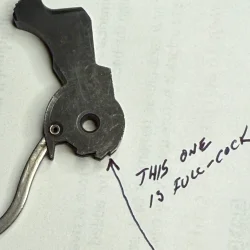
Here ya go...
JohnHL
Member
- Joined
- Aug 6, 2013
- Messages
- 3,865
- Reaction score
- 6,437
- City & State/Province
- Foothills of the Ozarks
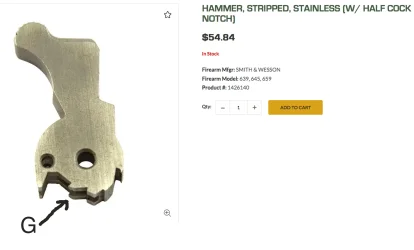
Hi again. Attached is the picture of the hammer I am considering. Is Marker G the single action notch that I would grind down?
Should I order it with the hammer spring guide rod, or is it easy enough to drive the pin out and use the old rod?
No, that's the throw notch.
two more notches to the right or, counting down from the strike face...
The first one is half-cock, disregard that one. The second is full-cock, that the one to wipe.
Simple matter to swap the stirrup and pin it onto the replacement hammer.
Hang on a sec, let me dig up a hammer and post a pic.
Cheers
Bill
Yes, Harry that is a hammer that will work but no, that is the wrong notch.
The correct notch to remove is the second from the front (Notch "B" from your illustration in your post #6) just as Bill says.
I see you have been window shopping on the Numrich website and the hammer you have chosen is a 2nd gen hammer as evidenced by the half cock notch in the very first position on the front of the hammer.
I saw that hammer on Numrich and it is the hammer I would have chosen if I had wanted a spur hammer or I was willing to grind it off.
The hammer I would have most likely chosen was this one:
https://www.gunpartscorp.com/products/335890
It is from a model 669, but it is spurless (like S&W provided on all DAO pistols) and has the half cock safety notch.
It does have the shorter hammer spring guide rod ("stirrup", in S&W parlance) but as Bill said, it's easy to swap.
BTW, the picture of the blackened hammer Bill provided is from a 3rd gen pistol and lacks the half cock notch.
That's why the single action (full cock) notch is the first notch from the front in his picture.
John

Revelation
Member
HOOYAH Master Chief!None of the above. Those hammers are unique to the XX26 frame decocker guns and have two more notched over the regular TDA hammers. You want a three notch hammer like is in your gun now. B=fullcock notch, C=pickup notch, D-throw notch
Rather than ruin a serviceable original part, swap in a factory DAO hammer assembly.
https://jackfirstinc.com/product/sw...y-stainless-models-4043-4046-4054-1040-20279/
Also note the DAO guns use a different trigger assembly so...
https://jackfirstinc.com/product/sw-1000s-trigger-double-action-only-304-wide-pad-1040-26221/
Also, remove the rear release lever and install this spacer in it's place...
https://jackfirstinc.com/product/sw...-spacer-double-action-only-models-1040-23388/
Since the manual safety body no longer has a function, it can be removed.
To fill the hole a factory firing pin retainer may be fitted.
https://www.gunpartscorp.com/products/347300
Or you could sell the thing and go find a 4546.
Cheers
Bill
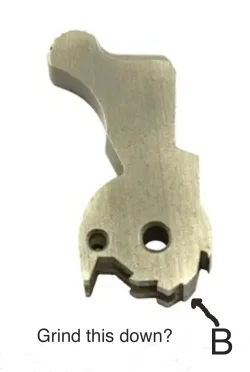
Hi, one more time and then I will quit bugging you kind gentlemen.
If I order this hammer:
https://www.gunpartscorp.com/catalogsearch/result/?q=1426140
and grind down notch B, I will have a double action only 645?
If I order this hammer:
https://www.gunpartscorp.com/catalogsearch/result/?q=1426140
and grind down notch B, I will have a double action only 645?
Attachments
BMCM
US Veteran
Yup, that's the full-cock notch

Listen to Bill when he cautions against doing something. He knows of what he speaks.
JohnHL
Member
- Joined
- Aug 6, 2013
- Messages
- 3,865
- Reaction score
- 6,437
- City & State/Province
- Foothills of the Ozarks
Yes, Sir!Hi, one more time and then I will quit bugging you kind gentlemen.
If I order this hammer:
https://www.gunpartscorp.com/catalogsearch/result/?q=1426140
and grind down notch B, I will have a double action only 645?
You've got it.
John
The disconnector's function is to serve as a passive mechanical safety solely to prevent an out of battery detonation.
It prevents the hammer fall if the breech is not fully in battery and locked.
If the slide is out of battery, the disconnector pushes down on the drawbar leaving a dead trigger.
Thereby preventing blowing the grips off the gun, blasting the contents of the magazine out the bottom, and no brass shards embedded in one's hands & face.
Removing the disconnector is a very VERY bad idea.
Cheers
Bill
BMCM,
Spent a few days looking and thinking, and I have to respectfully disagree. I believe the 457 disconnector’s purpose is to push the drawbar away from the sear *after* the shot is fired, allowing the sear to capture the hammer for the next (SA) shot. While the disconnector may also theoretically prevent out-of-battery firing, I don’t see it happening.
Taking my 457 apart and measuring on the barrel where the takedown pin has marked it, it looks like the barrel becomes fully lowered/unlocked once the slide has traveled roughly the first .24” rearward.
The firing pin (inertial) when free protrudes about .05” from the slide face.
After firing, once the slide has retracted around .1” or less the hammer (as it rotates rearward) has been raised enough from resting position that it no longer touches the firing pin. It cannot touch the pin again until the last .1” of slide travel as the slide closes.
Obviously the barrel is in varying degrees of being unlocked over the first .24” of travel, but within the first .1” the hammer cannot touch the firing pin any more. The hammer is off the pin before the barrel is unlocked. It would seem an out-of-battery event due to the firing pin is quite unlikely.
(Naturally the firing pin safety prevents this also, but I’m ignoring that for now. Also, the energy the hammer has to impact the primer is going to be much lower with a DAO hammer following the slide forward than with an SA drop.)
For comparison you might look at the CZ 1945, a blowback 25acp with a similar DAO design, which has neither disconnector nor firing pin safety.

IAM Rand
Member
Or here is an idea, don't ruin a perfectly good gun and just go out and buy a DAO. Never understood cutting up or filing down something on a perfectly good firearm. If you want to do that, go out and buy a Ruger or something like that.

Frank Black
Member
Is it possible to modify a Model 645 to fire double action ONLY, without it becoming full auto?
This. ^^^ …….. I’ll add my vote for NOT mangling a perfectly good 2nd Gen 645.Or here is an idea, don't ruin a perfectly good gun and just go out and buy a DAO. Never understood cutting up or filing down something on a perfectly good firearm. If you want to do that, go out and buy a Ruger or something like that.
Pro tip: S&W ain’t making them anymore.

 Naaaa, I will disagree. If he’s buying alternate parts and swapping those in, he’s not ruining anything. And the 645 is just an old 80’s war horse that is probably remembered more fondly for its television role than any role it actually played in real life.
On the other hand, seeing phenomenal (real) PC Limited and absolutely elite target guns turned in to DAO pistols is something my brain cannot decipher.
Frank Black
Member
Have to disagree. Back in the day, in my A/O, there were at least 5 police agencies/departments (and one S/O) that issued the M645.
Sure, eventually they upgraded to 3rd Gens or transitioned over to Glocks or Sigs, but many officers bought their 645s (at a very discounted rate) if the department offered that option.
As I recall, more than few such guns made their way to dealer tables at Fun Shows of that era as alleged “L.E. trade ins.” I’m quite sure such guns had been bought off the officers for quick cash by the dealers only to be “flipped” at the shows for more $$$. …. Such is life.
Last edited:
JohnHL
Member
- Joined
- Aug 6, 2013
- Messages
- 3,865
- Reaction score
- 6,437
- City & State/Province
- Foothills of the Ozarks
Being ever mindful of the admonition uttered by my fellow Missourian, Samuel Clemons (Mark Twain): "Never argue with an idiot. They will drag you down to their level and beat you with experience.", I am loathe to engage with trolls.
However, if only for my own personal edification, please enlighten me:
How does the modification of a spare (not original) part (as discussed in the above referenced thread) constitute a ruination or mangling of the OP's pistol?
John?
However, if only for my own personal edification, please enlighten me:
How does the modification of a spare (not original) part (as discussed in the above referenced thread) constitute a ruination or mangling of the OP's pistol?
John?
Similar threads

- Replies
- 4
- Views
- 209

- Replies
- 7
- Views
- 394
- Replies
- 18
- Views
- 551


