- Joined
- Nov 22, 2010
- Messages
- 260
- Reaction score
- 532
This is a story of my second Second Model Hand Ejector. It’s a bit of a tale...
From the beginning of my N-frame interest I have been keeping my eyes open for a good deal on a 44 Hand Ejector. The term “good deal” means different things to different folks since 44 Hand Ejectors are, by and large, scarce and expensive compared to many other S&W’s. Further, the First Model, the venerable Triple Lock, is even scarcer and expensiver than the rest of the 44HE models! Since most Forum members have some understanding of the pricing of those I won’t go into it here. Suffice to say that when I saw one for <$500 I was immediately interested, and a wee bit skeptical.
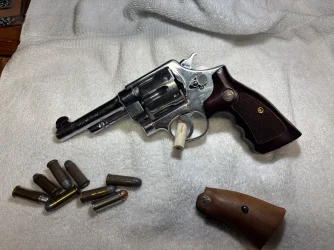
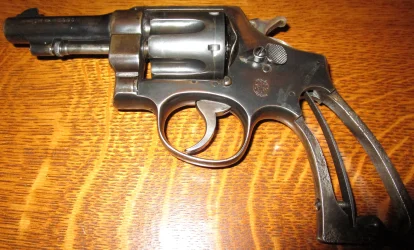
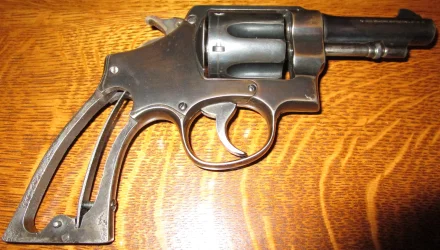
The gun pictured here was advertised on Armslist and was on the opposite coast from me. Listed by a private seller, it was one of three low-cost revolvers, with shipping indicated as “No”. I watched the ad, along with 44 HE’s listed on other gun sights. Those other 44’s all carried the expected price tags, generally $1500-$2500. So after a few weeks I decided to reach out to the seller. We exchanged messages and after a time I asked if he would consider shipping for some additional cash to cover shipping costs and his trouble.
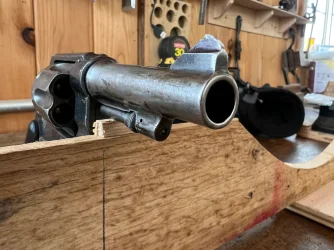
In response I received several additional pictures and a phone call. The seller explained that he generally didn’t ship since he did not want to get into a situation where a buyer was not clear on what he was buying and everyone ended up unhappy. Using the additional pictures, he explained that the barrel had been shortened and the gun re-plated. The original grips were long gone and in their place were a pair of Altamont service replacements, which neither of us found particularly flattering on the nickeled N-frame. The hard parts were all original and all of the numbers matched. The gun was reported to function fine. He stated that he thought he could use a local shop to ship it and was willing to do so. We made a deal.
Of course, Murphy’s Law, nothing is ever easy, pick your analogy, I was still a ways from holding my 44 HE. He had requested payment via USPS money order, which necessitated a trip to the post office. I put the MO and my C&R in a Priority envelope on a Tuesday, expecting it to arrive on Thursday. Some of you who inhabit the North or East of the US may recall there was a bit of a snow storm in January. “Neither rain nor sleet nor dark of night!” they said. Apparently that storm was more than the slogan allowed as “Delivery delayed due to weather” was the status for the next week. On day eight or ten I went back to USPS and asked them to put a trace on my package. A couple of days later the seller let me know he had received it and would ship the next day or so. Apparently the new help at the local shop said they no longer shipped guns. The next shop said yes but only on Monday, which meant another week wait. After another two weeks of waiting a package appeared at my door containing my new-to-me 44 HE!
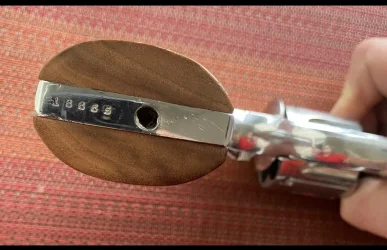
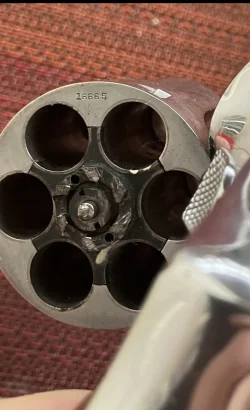
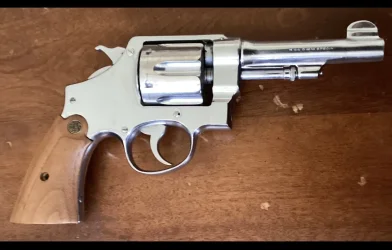
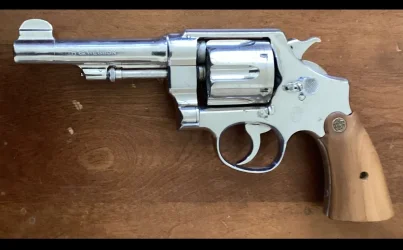
She was beautiful, in a well-used shooter sort of way. The good news is that based on previous owners mods I don’t absolutely have to keep it original. The other good news is for the price I have improvement options. The gun has serial number 16665, which I think puts it ~1921. Frame, cylinder, and barrel all match. Lockup and timing are good for the age.
The grips had to go first thing, though the N-frame grip choices in my drawer were few. With the short barrel and the N-frame I prefer a beefier looking grip. It is currently wearing a pair of aftermarket targets, though they are not great. I have a set of Hogue wood grips coming from a member here that I think will look good; still waiting for those.
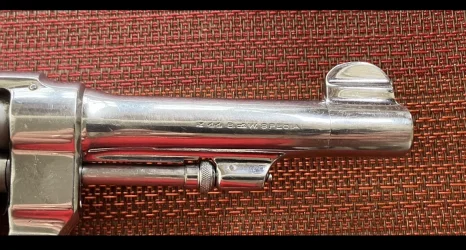
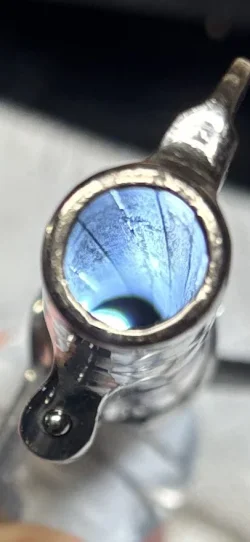
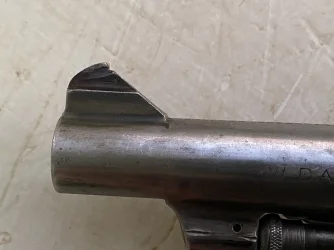
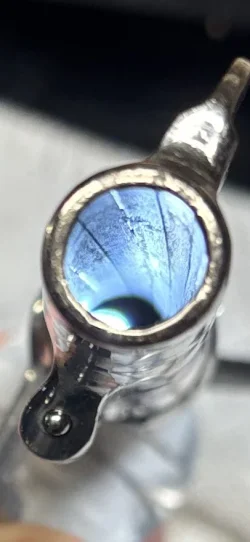
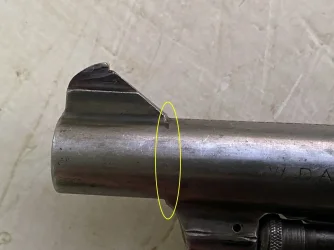
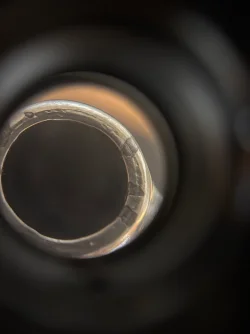
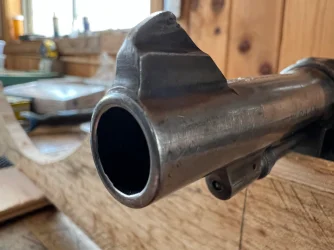
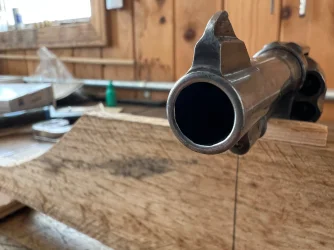
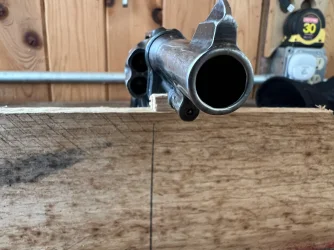
The barrel was cut just behind the sight to 4 1/2”. The rifling seems well aligned and continuous, but the parting line was not well filled in on the outside. I would like to keep the serial numbered barrel but will see how she shoots. If the grouping is poor I have some options: I could swap the barrel and cylinder for a 29 / 629 set, both of which are available. Or rebore and rechamber for 45LC (or 45ACP, though ACP will cause me to lose the SN on the cylinder face.)
I actually do not like plated triggers and hammers. The plating on the hammer is thick and filled in the grooves, which makes the hammer slick. I am picking up a matched target trigger and hammer set to try. We will see how that feels and if it looks obnoxious.
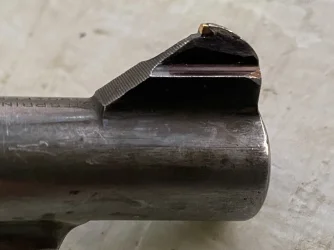
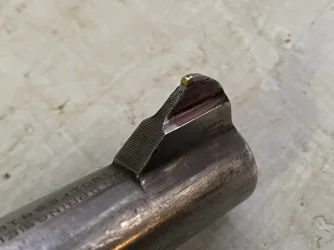
The 1917 Commercial I posted yesterday has had some ramping done to the sight, I might consider that on this gun also as the flat front sight surface, especially with some color, is really helpful to me. If I end up with a new barrel (eg 629) I will have the frame machined for a matching rear sight.
Or I may just leave it as is, a 100yr old survivor. That is part of the fun of this hobby for me, the choice to leave it or build it, learn what I can do myself vs what I need someone experienced to do, see what upgrades owners engaged in before me, and of course, shoot. It is another non-collector piece, which fits my style just fine. As a result of a couple of gun deals I now also own a 29-2 and (almost) a 629-6 Classic. So that has sated my 44 desires for the moment (these seem to come in 3’s for me). I will keep looking for another classic pre-model 44 HE, maybe a pre-24, but will wait for the right shooter at the right price to come along. Thanks for sharing my find
From the beginning of my N-frame interest I have been keeping my eyes open for a good deal on a 44 Hand Ejector. The term “good deal” means different things to different folks since 44 Hand Ejectors are, by and large, scarce and expensive compared to many other S&W’s. Further, the First Model, the venerable Triple Lock, is even scarcer and expensiver than the rest of the 44HE models! Since most Forum members have some understanding of the pricing of those I won’t go into it here. Suffice to say that when I saw one for <$500 I was immediately interested, and a wee bit skeptical.
The gun pictured here was advertised on Armslist and was on the opposite coast from me. Listed by a private seller, it was one of three low-cost revolvers, with shipping indicated as “No”. I watched the ad, along with 44 HE’s listed on other gun sights. Those other 44’s all carried the expected price tags, generally $1500-$2500. So after a few weeks I decided to reach out to the seller. We exchanged messages and after a time I asked if he would consider shipping for some additional cash to cover shipping costs and his trouble.
In response I received several additional pictures and a phone call. The seller explained that he generally didn’t ship since he did not want to get into a situation where a buyer was not clear on what he was buying and everyone ended up unhappy. Using the additional pictures, he explained that the barrel had been shortened and the gun re-plated. The original grips were long gone and in their place were a pair of Altamont service replacements, which neither of us found particularly flattering on the nickeled N-frame. The hard parts were all original and all of the numbers matched. The gun was reported to function fine. He stated that he thought he could use a local shop to ship it and was willing to do so. We made a deal.
Of course, Murphy’s Law, nothing is ever easy, pick your analogy, I was still a ways from holding my 44 HE. He had requested payment via USPS money order, which necessitated a trip to the post office. I put the MO and my C&R in a Priority envelope on a Tuesday, expecting it to arrive on Thursday. Some of you who inhabit the North or East of the US may recall there was a bit of a snow storm in January. “Neither rain nor sleet nor dark of night!” they said. Apparently that storm was more than the slogan allowed as “Delivery delayed due to weather” was the status for the next week. On day eight or ten I went back to USPS and asked them to put a trace on my package. A couple of days later the seller let me know he had received it and would ship the next day or so. Apparently the new help at the local shop said they no longer shipped guns. The next shop said yes but only on Monday, which meant another week wait. After another two weeks of waiting a package appeared at my door containing my new-to-me 44 HE!
She was beautiful, in a well-used shooter sort of way. The good news is that based on previous owners mods I don’t absolutely have to keep it original. The other good news is for the price I have improvement options. The gun has serial number 16665, which I think puts it ~1921. Frame, cylinder, and barrel all match. Lockup and timing are good for the age.
The grips had to go first thing, though the N-frame grip choices in my drawer were few. With the short barrel and the N-frame I prefer a beefier looking grip. It is currently wearing a pair of aftermarket targets, though they are not great. I have a set of Hogue wood grips coming from a member here that I think will look good; still waiting for those.
The barrel was cut just behind the sight to 4 1/2”. The rifling seems well aligned and continuous, but the parting line was not well filled in on the outside. I would like to keep the serial numbered barrel but will see how she shoots. If the grouping is poor I have some options: I could swap the barrel and cylinder for a 29 / 629 set, both of which are available. Or rebore and rechamber for 45LC (or 45ACP, though ACP will cause me to lose the SN on the cylinder face.)
I actually do not like plated triggers and hammers. The plating on the hammer is thick and filled in the grooves, which makes the hammer slick. I am picking up a matched target trigger and hammer set to try. We will see how that feels and if it looks obnoxious.
The 1917 Commercial I posted yesterday has had some ramping done to the sight, I might consider that on this gun also as the flat front sight surface, especially with some color, is really helpful to me. If I end up with a new barrel (eg 629) I will have the frame machined for a matching rear sight.
Or I may just leave it as is, a 100yr old survivor. That is part of the fun of this hobby for me, the choice to leave it or build it, learn what I can do myself vs what I need someone experienced to do, see what upgrades owners engaged in before me, and of course, shoot. It is another non-collector piece, which fits my style just fine. As a result of a couple of gun deals I now also own a 29-2 and (almost) a 629-6 Classic. So that has sated my 44 desires for the moment (these seem to come in 3’s for me). I will keep looking for another classic pre-model 44 HE, maybe a pre-24, but will wait for the right shooter at the right price to come along. Thanks for sharing my find
Attachments
Last edited: