
Top break latch?

coyotejoe

Member
Joined
May 8, 2015
Messages
31
Reaction score
8
City & State/Province
Troy, MT
Howdy, been away for a while but I knew this would be the place to get an answer. My question is in general regarding the design of the top latch. I've become interested in the small pocket pistols of the late 19th and early 20th century. Most of these are break top designs and most of the latches are of the inline design which I consider a very poor design since the latch itself must take the thrust of firing. I've always thought a much better design had a mortise in the extended top strap to close over a raised stud on the standing breech so that the latch need only hold it down. That makes a lock up as strong as a solid frame. Examples would be the Scofield and the Webley revolvers. Some few American top breaks also employed this design. I see that the S&W Safety Hammerless had a similar latch at one time but by far the most employed the common weak inline latch. I'm wondering which models employed the stronger latch setup?
I've attached a photo (if it works) of a cracked latch and bent latch screw from a cheap top break which shows the weakness of that design
 

Attachments
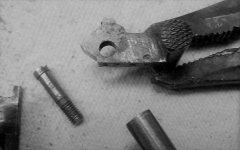
  • Cracked top break latch.jpg
    Cracked top break latch.jpg
    67.3 KB
Last edited:
Thanks for the welcome. From what I'm seeing on internet photos there appear to have been at least three different latches tried over the several generations of the Safety Hammerless.
 
The 1st & 2nd Schofield, 1st .38 Safety and the 1-3 .32 Safety come to mind. After those, the latch was (as you describe): in-line
 
I have owned many top-break S&Ws and never had a problem with any top latches, but I try to buy only solid lock-up, not abused guns. They have remained that way after all have been shot at the range many times over the years. The system must have been quite effective for S&W, since all Americans, Russians, Schofields, New Model 3s, 44 Double Actions, plus 32 Single Action, 38 Single Actions, 32 Double Actions, 38 Double Actions, 32 Safeties, 38 Safeties, 38 Perfected revolvers, and Single Shot Target pistols had top latches.

As for the types of locking mechanisms found on Safety revolvers, there are two different latches found on the 32, with the first being a push button rear latch that was changed out to a standard top latch around 1902. The 38 Safety had four changes made to the top latch over its production range. The first was called the "Z-Bar" which utilized were two different push button designs found on the sides of the top latch, there were also two types of push button latches on the 2nd & 3rd Models, and finally a standard top latch was adopted in 1898 with the 4th Model.

Can these latches fail, absolutely - but it takes deliberate abuse or over-pressure loads to break them in my opinion. Remember that these guns made the transition from black powder to smokeless with no changes in design, but when owners made that same change while reloading, the results could have been parts or gun failures. It was not an uncommon mistake to load early smokeless powders the same way as reloaders loaded cases with BP, fill the case with powder, leaving just enough room to seat the bullet. Obviously, if the gun did not blow up, parts would have been stressed beyond any normal limits.
 
Last edited:
Thanks, that is exactly what I wanted to know, you guys are a great bunch.
 
Actually I think the top break latch mechanism is fairly strong. Look at heavy machinery chain. You can harness alot of horsepower with multi row chain. I once ran a drilling rig with 3 398 Cats (V12s) and they were linked together and to the draw works with machinery chain and that rig was rated to lift 1 million lbs. The pins on that roller chain were only about 1/4" in diameter, but 4 to 6 links wide depending on location. A top latch has 3 points similar to 2 link wide chain and even my little 32s use about a 1/8 pivot. My 44 Russian has a slightly larger pin, bigger posts and the "links are heavier. As long as the lock up is tight and in line it can take a pretty good load. Now slack in the lock up would cause a shock load and that is bad. But then look at the early Colt revolvers that had no top strap and just a wedge to hold the barrel to the frame.

Although I don't think something like a 44 mag or a 500 would work out with those sized latches I think one could be made. When revolvers blow up it is almost always the cylinder that lets go and takes out the top strap. I have never seen a top strap failure where the cylinder was intact. But, I suppose it has happened.

Look at the locking lugs on bolt action rifles they work square to each other

How may have seen a top break that had the latch fail?
 
Well I posted a photo of one in my original post and in fact most of the old break top guns if they have seen any use at all are lose, even .22's. Now admittedly I'm not talking Smith & Wesson but guns of lesser quality, still, latch failure is the number one problem with those guns.
 
".. but guns of lesser quality, still, latch failure is the number one problem with those guns." And they are not made by Smith & Wesson.. there might be a lesson to learn in there somewhere.
 
I must admit that once again as a new member and new collector as in I haven't actually bought a top latch yet but have my eye on one you guys are truly amazing in your knowledge of revolvers and also engineering in general .We have gone from black powder loading to heavy machinery building in this one thred .You are an amazing group of people impressive.
 
".. but guns of lesser quality, still, latch failure is the number one problem with those guns." And they are not made by Smith & Wesson.. there might be a lesson to learn in there somewhere.
Sorry if I ruffled some feathers here, didn't mean to butcher a sacred cow. MY point was that there are better designs, not that you can't limp along with a poor design.
In Ken Waters book of pet loads he lists some .38 S&W loads with the usual warning that they are not intended for small top break guns and adds this "and in saying this I don't have reference to only the cheaper makes either, having once seen the latch blown off a fine S&W Perfected Model in almost new condition." He goes on to say the British Webley and Enfield revolvers are safe. Having owned several Webley & Enfield revolvers both large and small I certainly don't consider them to be of S&W quality but even when the soft internals are worn out they still latch up tight, their design does not demand the finest metallurgy and workmanship to compensate for a poor design.
 
If I remember correctly, Ken Waters was an avid wildcatter and pushed the limits of many firearms, but he apparently does not know much about S&W Models. The Perfected was a double locking revolver that locked up like a solid I frame revolver. plus had a top-latch. The last top-break design introduced by S&W and saw a total production of almost 60,000 from 1909 to 1920.

The combination of a thumb release mechanism, (where the cylinder pin that travels through the cylinder and locks into a recess in the rear frame) as seen in all solid frame S&Ws plus a top-latch makes it just about impossible for the top latch to fail without the second locking mechanism breaking as well and more likely the gun blowing apart. Any standard loading would do nothing to this gun, so who knows what the situation was that Ken referenced. Maybe someone was wildcatting the 38 S&W?? I can reference failures in just about any firearm ever manufactured, including today's models, so vague references about failures, are not scientific evidence of the inadequacies of any particular design of any brand or model revolver. If you remain very concerned about top-latch revolvers, don't buy or shoot them.
 
No ruffled feathers here; but I do like beef. I believe Smith & Wesson recognized the limits of their top break design and that research lead to their solid frame design; larger calibers, higher pressures driving faster loads, etc.. Still, there have been catastrophic failures in that design too. Was Ken Waters in the room?
 
The simple truth is that the early top break design was a product of the 1870's and were designed for Black powder use only. The introduction of smokeless powder brought on a lot of significant problems for the older guns. The older top breaks also had black powder rifling. Wide lands and grooves. Pressure spikes that exceeded their design would occur with smokeless powder use. The latch and catch were not engineered to sustain this type of abuse. Hense the damage. It is true that top latch models continued into the smokeless era but they were more often backed by the engineered addition of a side latch that became the standard after the 38 perfection model was discontinued. Lets also remember that these are aged firearms that have "seen the elephant" many times. Lets cut them a little slack.
 
. . . The introduction of smokeless powder brought on a lot of significant problems for the older guns . . . Pressure spikes that exceeded their design would occur with smokeless powder use. The latch and catch were not engineered to sustain this type of abuse. Hense the damage . . .

The top-break S&W revolver was manufactured up to WWII and remained in S&W catalogs for almost the first half of the Twentieth Century with no mention of black powder being required. Almost all guns made the transition from black powder to smokeless without notice, by the early 1900s. There were no significant design changes made to these guns from pre-1899 days and ammunition companies still manufacture 32 S&W, 38 S&W, 44 Russian, 44-40, etc.

The 38 Perfected revolver was the only top-break to add the thumb latch and was not a popular gun, partly since it was competing with new solid frame revolvers that shot more powerful higher velocity ammunition than was available with previous models and calibers. Take a look around the Forum for many threads and posts with differing opinions, many backed by research, and experiences.
 
My original post was intended just to discuss the variations in the latch arrangement. It seems that in 50 years of production they went through 5 different latches and , from an engineering perspective, it would appear that the earlier latches would be the stronger and more durable. It seems they never were happy with any of the latch arrangements but kept experimenting to the end.
My interest in the Safety Hammerless revolver in general was spiked by my recent acquisition of a couple of old books by Julian S. Hatcher and Elmer Keith. Both spoke favorably of the revolver for personal defense. Neither were especially thrilled with the "stopping power" of the .38 S&W cartridge, though both rated it much superior to the .380 ACP and both commented that it could be improved by hand loading with Keith's 160 grain semi-wadcutter bullet which was then (circa 1930) something new to the shooting world.
I have recently acquired a Safety Hammerless in what I believe to be the third variation and will post photos when it arrives.
 
I may be lucky, but I do not own any with movement and only a few with an audible clicking, but no perceptible play in the latch. I guess it is a normal metal wear issue in most cases, since some of these old top-breaks may have been opened and closed thousands of times.
 
Question, please. In general how much play if any at all is found acceptable? I wish all of these old pistols would be rock solid when closed but most I personally saw - not many - had some little play in there when closed.

Well that is a function of the latch design. The rotary motion around the hinge pin starts out as mostly upward motion, then arching forward. That is why a latch designed to hold the top strap down against the frame, like the Webley, the Scofield and some of the other early S&Ws will remain tight while a latch designed to hold the top strap "back" against the standing breech will become lose after very little wear. It's like a chain across a door will always permit the door to open a certain amount versus a solid latch which can be fitted up quite tight and will stay tight.
 
Not quite on the topic at hand, but an old friend of mine used to mention that he worked summers, between college semesters, for William Crites who ran a gun shop in San Antonio, Texas in the late 1920s and early 1930s. He said that whenever top break revolvers were brought in for repair, the old man would wait until the customer exited the shop, open the revolver and rap it smartly against his work bench until the latch would lock tightly again and pronounce it "fixed."
 
Think of the evolution of the revolvers in USA. The Colt Walker, Dragoons, 1851 Navy and 1860 Army had NO top strap. The barrel held in solely by a tapered wedge and a line up pin.

Makes you wonder how much stress is actually placed on top strap and latch on the top breaks. Also, the frame / barrel assembly when fired with proper loads.

I've seen and handled many "well used" top break revolvers. Yes, the average, utilitarian or military use revolvers get loose and sloppy over time ... to a much lesser extent the Schofields.

Big mistake that S&W didn't want to pay the royalty to Gen. George Schofield to continue using the Schofield type latch / catch assembly.

However, a well cared for and maintained top break provides many years (to decades to now centuries) of faithful service albeit they have not been in daily use all that time.
 
That's very interesting about the topbreaks making it to WWII. I stand corrected. I could only find one in the model 5 hammerless 38 that made it to 1940. The perfected model sold almost 60,000. I'd say that rates for some popularity. My research of antique firearms transitioning to the new era of smokeless actually did see some form of change. Not necessarily to outward appearance but metallurgy and bore dynamics that must be mic'd to be understood. As an example, the .38 special was introduced and remains at .358. The original 38 S&W mic'd at .361. These changes were purposely done by the industry to protect the older guns when using smokeless powder to introduce lower pressures. I have not performed a bore study of the Smiths but this must have happened also or dangerous pressures would have been introduced to the older guns having black powder lands and grooves vs modern guns having narrow lands and grooves and reduced bore size. I would like to see a later model topbreak post 1900 and compare the bore rifling. Would be willing to bet that the rifling changed significantly. "Without Smith telling us about it". This to reduce pressure spikes from Smokeless powder use.
 
That's an interesting thought on the change of bullet diameter to afford a pressure reduction but I'm not sure it applies since the SAMMI specs for .38 S&W still specify a .361" bullet diameter and most other cartridges retain their original diameter.
One pressure reduction practice I have observed is with the typical "Saturday Night Special" revolvers by Harrington & Richardson, Iver Johnson and such. All of those I have examined have unthroated chambers, meaning the chamber is bored full case diameter straight through. If you remove the cylinder from one of those you'll find you can drop a cartridge into the front end as easily as the rear. That of course makes accuracy hopeless since the bullet has room to wobble through the oversize chamber to strike the forcing cone off center and crooked. But it no doubt also reduces chamber pressure by allowing powder gas to blow by past the bullet.
 
Yes Sir, I did not perform a study on the Smiths. There were additional methods used by manufacturers to reduce pressure. Changes to land(rifling design) was by far the most common. Black powder barrels having wide lands (for the most part) there are always exceptions. All of the top break Smiths that I have examined have the black powder lands. But my study on them isn't really a study at all but the old and most common "eye ball test". You would have to perform a bore dynamic comparison with the early models as compared to the later models. Also a close examination of the rifling. Bottom line is there "must be" a difference. It might be subtle but it's there. Maybe when I get a chance I'll slug a few late models and post my results in a few days. I do have a perfection model that dates to post 1900. I'll dig that one out and compare the bore dynamics to the earlier Black Powder era variations. At this point though based on research from other firms, I'd put money on there being a detectable and consistent change with my caliper.
 
I guess I don't understand why you say "there must be a difference". Most of our revolver cartridges and many rifle cartridges were originally loaded with black powder and smokeless powder loads were introduced for all of them. Even such outdated numbers as the .44 Henry rimfire were factory loaded with smokeless powder before finally being discontinued. Those smokeless loads were intended to be safe to use in the existing firearms of the day.
While smokeless powder certainly "can" produce higher pressures than black it does not have to do so. The ammo makers did much experimenting and testing before releasing new loads to the consumer. They made certain their ammo was compatible with existing firearms of the day, even if that meant settling for somewhat lower velocities than the full black powder load. Even today many factory loaded cartridges fall short of the velocities of the original black powder loads in order to assure pressures are safe in original firearms.
 
Last edited:
Yes Sir, I did not perform a study on the Smiths. There were additional methods used by manufacturers to reduce pressure. Changes to land(rifling design) was by far the most common . . . Bottom line is there "must be" a difference. It might be subtle but it's there . . . I do have a perfection model that dates to post 1900 . . .

Sorry, but I believe you might be reaching for straws here. You will find no difference in the rifling between pre-1898 and post 1898 top breaks. Many top-break S&Ws were made well past 1900. 32 DA mfg. 1919; 32 Safety mfg. 1927, 38 DA mfg. 1911; 38 Safety mfg. 1940; 44 SA (NM3) mfg. 1913; 44 DA mfg. 1913. These revolvers remained the same design, same materials, and the same rifling. The only change was that the post 1900s guns shot smokeless and the pre-1900 guns shot BP, all without concern over the small differences in ballistics.

I checked my antique 38 Double Action revolvers and compared them to my collection of 38 Perfected revolvers to find no difference in rifling, twist/pitch, lands or grooves. Also, you will notice that I did not call the 38 top-break with a thumb release a "perfection", but rather by the name both the company and collectors call it.
 
Ok, the wife went shopping so I managed to get some time in the shop. I pulled out the Perfected model and several earlier models.(Not perfection My fault: I was in the Utility business(explosive gas trainer) for 33 years and terms tend to co-mingle). I didn't eyeball the rifling but I did get out my multiple calipers and slugged 6 barrels in all. The land and groove design is visibly the same. But that's not what I'm trying to convey. The caliper is telling me that there is a difference between the earlier & late variations. I slugged and mic'd the models II and III.( I'm not hammering on my near mint model 1 thank you)..I also slugged and mic'd the perfected model. The earlier models have a .359 groove diameter. Matched on the model II and III's. With a land diameter of .353,.352,.352,.353, &.352. This variation is due to normal rifling wear. The Perfected model mic'd at .356 groove diameter with a bright and perfect bore having sharp but visibly shallow .354 rifling. This represents only a preliminary test. In order to perform a more accurate test I would have to slug and mic at least 20 of each variation. I would also like to slug the later models that date to 1940 or close to it. But this test not only suggests the bores are different but that the earlier variations had larger grooves and taller lands as compared to the grooves. You would also have to compare earlier black powder manufactured rounds, which we already know would mic at .361. To the later light loads of smokeless. Heeled vs hollow based? .361 vs. say .358/.357? I know, it's not a "HUGE" difference but it does in fact consistently register on a caliper and it was obviously done on purpose!
I also performed a "complete" and thorough test for the .41 caliber derringers of the black powder era. This was performed for a book that I wrote on the .41 rimfire short. "Huge difference" in Groove and Land Diameters. In fact that B.S. stigma associated with the Remington Double derringers being under powdered??? 400 FPS normal. That's wrong! There was a groove change on those that took place about 1896. I documented that in my book on 41's. It's obvious and yet nobody has bothered to mic the bores on them as well. They changed from .406 to .399!!! groove diameter at the turn of the century...Hense the smokeless era. The bullets also changed for the .41 rimfire from (.405-.411) to .401 in diameter at the same time. All this published info on the low velocity of the .41 is simply based on shooters using the "wrong" (Undersized ) bullet for the bore in question. This just further supports that the industry did in fact make changes to bore dynamics to protect the earlier guns from smokeless powder issues. That's all I'm saying fella's.
 
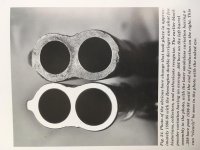
Remington bore change.jpg

Here is a photo from my book on .41's. You can see the bore change without a caliper. This took place during the industry's change to smokeless powder. About 1896.
 
I have to stop doing all these side jobs, since I am retired and have too many fun things to do. Measured about 15 guns, both sides of the 1898 date. I can find no correlation between antique and post-antique guns. Certainly nothing that a soft lead bullet cannot handle with little or no difference in pressures. As I mentioned before, no change is design or barrel rifling and diameter by what I am observing and I have never read any accounts of barrel changes made during or after the transition from BP to smokeless.

The chart below includes models, serial number ranges, measurements, and ship dates.

38 Perfected, 1st Model . . . . . . . . 8,XXX . . . .361 . . . .1912
38 Perfected, 1st Model . . . . . . . 38,XXX . . . .359 . . . .1913
38 Perfected, 2nd Model . . . . . . .57,XXX . . . .360 . . . .1919
38 DA, 3rd Model . . . . . . . . . . .222,XXX . . . .361 . . . .1889
38 DA, 4th Model . . . . . . . . . . .485,XXX . . . .362 . . . .1906
38 Single Action, 2nd Model . . . . 14,XXX . . . .362 . . . .1878
38 Safety, 2nd Model . . . . . . . . . 72,XXX . . . .361 . . . .1893
38 Safety, 3rd Model . . . . . . . . .115,XXX . . . .360 . . . .1902
38 Safety, 4th Model . . . . . . . . .200,XXX . . . .360 . . . .1906
32 Single Action . . . . . . . . . . . . .56,XXX . . . .312 . . . .1871
32 Safety, 1st Model . . . . . . . . . . .4.6XX . . . .312 . . . .1889
32 Safety, 2nd Model . . . . . . . . 217,XXX . . . .312 . . . .1920
32 DA, 2nd Model . . . . . . . . . . . .20,XXX . . . .311 . . . .1881
32 DA, 4th Model . . . . . . . . . . . 247,XXX . . . .310 . . . .1905
32 DA, 5th Model . . . . . . . . . . . 272,XXX . . . .311 . . . .1905
 
View attachment 303361

Here is a photo from my book on .41's. You can see the bore change without a caliper. This took place during the industry's change to smokeless powder. About 1896.

I know that early 41 RF, and many other RF and centerfire cartridges, used heeled bullets, meaning that the bullet was the same size as he outside dimensions of the case. Later designs inserted the lube rings into the case, making the bullet smaller, while still being able to use the same size casings. This allowed the use of the modern ammo in older guns, since the chambers did not have to be altered. It is also reasonable that the new guns would reduce the bore diameter to accommodate for the smaller bullets. I do not believe that it had much to do with smokeless powder, but rather there was much criticism about outside lubed bullets picking up dirt and debris and losing their lubricity over time. References have been made that the Russians facilitated the change from the 44 American (heeled bullet) to the 44 Russian (internal lubed bullet) caliberr for that very reason.
 
Last edited:
Back
Top