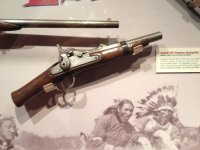

Trapdoor Springfields?

I have fired several originals all infantry versions and a few sporterized jobs. Trap doors started out as breech loading conversion for Muzzel loader. The originals shouldn't be shot with any thing other than duplication of BP loading. Most cases they do best with lead bullets. Factory loads had be geared to allow using them in the old BP rifles. With
45/70 making a big comeback and all kind of buffalo loads being sold, be careful what you are shoving in it.

Thought I remembered something about the cavalry using .45-55 ?
 
Can these guns fire the Buffalo Bore high velocity ammo? I assume the repros can. Thoughts?
 
I have a original Springfield Trapdoor 1878 Model Rifle in 45/70 with a 32 1/2 inch barrel. I have been told they called this model a Long Tom Model. My best friend and the best shooting partner I ever had. Gave it to me just before He passed away. It is in very good shape and shoots extremely well out passed 200 yds. The load I use in it is 35grs of IMR3031 with a 405gr Hardcast LRNFP Bullet. The gun is just a hoot to shoot, but I don`t shoot it all that often. I am very worried I might damage it in some way, for I am not sure I should be shooting it at all.
ken
 
Guys thanks so much!! Do the original carbines command a premium over the rifles? Really desiring a carbine...

Do they ever. Especially if you find one from the Little Big Horn era. Just because one looks like a carbine, it may not be. Many rifles were cut back to resemble carbines. They can fool someone who doesn't know what to look for. Easy to spot by someone who knows carbines. Not all these "spurious" carbines were made with an intent to defraud. At one time rifles were cheap, and many rifle owners just "sporterized" them into carbines with a hacksaw.

I once found one of the "sporterized" trapdoor carbines in a museum display which was identified as an original carbine. I pointed out the fallacy and it was removed from display. Did the same thing regarding a Krag carbine in the same museum, also removed from display. Both guns had probably been there in the display case for many years with no one noticing the obvious discrepancies.

There was a great deal of interesting ammunition development performed at Frankford Arsenal during the time period the trapdoor was in U. S. military service, but that's a story for another time.
 
Last edited:
Can these guns fire the Buffalo Bore high velocity ammo? I assume the repros can. Thoughts?

NO!!!!! Not the originals OR the repos. I like trapdoors, I have owned several, but they are a weak action.


The rifles used .45-70-405 (bullet weight). Then the Army increased the rifle bullet weight to 500 grains. Some of this ammo was fired in carbines, but I don't think it was on purpose. :)

The Army did go to the .45-55-405 load for carbines.

"I have been told they called this model a Long Tom Model."

Don't know why the soldiers would call them that. The trapdoor rifles were about 7" shorter than the 1861 and 1863 rifle muskets that they replaced. Infantry carried the rifles and cavalry carried the carbines.
 
Last edited:
I see! I think I heard the Sharps can use the hot ammo. Doesn't seem the case for the Trapdoor. Not a problem, will stick to light loads and black powder reloads.

So guys, the Pedersoli carbine is about $1350 from most sources. How expensive are the original carbines in shootable shape? Do not need or desire a top specimen, just one that shoots decently and is stable.

Thoughts?
 
Can these guns fire the Buffalo Bore high velocity ammo? I assume the repros can. Thoughts?

I do not have the specs for the BB loads but check with them. They should know better than anyone.

IMO, no, the originals were designed for blackpowder and using original loads can shoot through most game animals. I load for an45/70 and a 50/70, Blackpowder and lead. It certainly does the trick.

Sorry, did not see this was answered by Miley Gil.

Kevin
 
Last edited:
...So guys, the Pedersoli carbine is about $1350 from most sources. How expensive are the original carbines in shootable shape? Do not need or desire a top specimen, just one that shoots decently and is stable

Thoughts?...

For that kind of money you can buy a very good specimen.

Check out this website for most anything you need to know about the Springfield Singleshot Breechloading Rifle.

The U.S. Springfield Trapdoor Rifle Information Center

Kevin
 
Still have the 1884 Trapdoor rifle given to me by a lady friend of my Mom.

This lady owned a few lower-end rental houses and had seen kids dragging around 'some big ol' gun' that a prior tenant had left at one of the houses.
I was about 13-14 and on my way to being a full-fledged gun geek.
Still have the carton of the first box of ammo I bought for it, 'Peters' 405 gr SP.
I had been messing with black powder cap and ball repro revolvers for a little while and devoured every Dixie Gun Works Catalog I could get.
Read a piece in one of them by Turner Kirkland about simple reloading using cases, an icepick and lead round balls.

I started doing that since I couldn't afford buying commercial ammo.
Taking the fired cases, and using a block of wood with a hole in it, I'd de-prime with an icepick, re-prime using a dowel and the wood block.
A dipper or so of FFFg black to about the mid-way point. Then a .457/.458 RB secured in place with a drop or two of Elmers.

I was way proud of being able to shoot my Trapdoor with ammo I could say I made. Match accuracy was not the goal fortunately.

Still have it, and it holds much sentimental value. The bore was in poor shape when I got it, but that sure didn't curb my pride of having it.

They are neat old rifles and I know for many years held no real value.
 
As far as ammunition for old or new Trapdoor rifles/carbines goes....the reloading manuals I own have three levels of load info for .45-70


Trapdoors and other 'weak' actions have the lightest loads listed for a reason. Brand new trapdoors still require lighter loads same as the original rifles.


Since I own two old trapdoors in .45-70 and a Browning 1886 carbine in same caliber...I just load .45-70 to 'trapdoor spec'. The Browning can undoubtedly handle heavier loads than the old original trapdoors...however the lighter loadings are much more pleasant to shoot in any of my three rifles.

I have no real use for super-duty .45-70 ammo. The cartridge works very well at or near original ballistics.
 
The Bible for reloading here is "Loading Cartridges For The Original .45-70 Springfield Rifle And Carbine" by J.S. and Pat Wolf.

While J.S. is gone, Pat still sells the book and other items at www.the45-70book.com

I have no financial interest in the book or website. Just in BP reloading to improve accuracy for a Model 1884 Trapdoor.
 
Last edited:
IMNSHO, the military should have armed themselves with Remington rolling blocks, as the RB action is much stronger. However, the War of Northern Aggression had cost a lot of money and even with the drastic cutback in strength of the military, there wasn't much money available for new firearms. The trapdoors used a lot of parts that were common to the rifle muskets that they were replacing.

The first TDs used a .58 rimfire round that was unsat. The Army was trying to use the same barrel as the muzzle loading rifle musket. Next was the .50-70, which was a big improvement. Then, in 1873, the .45-70 round was introduced. These rifles and carbines were in first line until 1892, when the Krag-Jorgensen was adopted. However, the TD hung around for many years. Volunteer troops used them in the Spanish-American War.

In 1916, James Thurber, the author of The Secret Life of Walter Mitty, drilled with a TD while enrolled in ROTC at Ohio State University.
 
Last edited:
Not really sure how “weak” the action is. It is certainly strong enough for blackpowder loads and right before the Spanish American War, Springfield texperimenting with smokeless loads.

Springfield also used the trapdoor action to test barrel metals for the Krag. They used several actions and test fired them with 30-40 ammunition to determine the proper steel recipe to use in the new rifle.

I am also aware of some rebarring done that would raise some eyebrows.

The early conversions done on muskets were certainly weak. After the Model 1873, all the parts were newly made and much stronger.

Kevin
 
"A carbine with the early 45-70 loads kicked the snot out of those troopers. Thus the Army reduced the load for carbines to 45-55-405 down from the Infantry rifle load of 45-70-500"

The chronology is a little different. The earliest issue trapdoor loads were .45-70-405 for both rifles and carbines. The recoil was a little ferocious when that load was used in the carbine, so the powder charge in ammunition for carbine use was dropped to 55 grains, creating the .45-55-405 cartridge. For this carbine load, a cork wad was used under the bullet to avoid the empty space above the powder. The ammunition for the carbine usually had an identifying "C" on the cartridge head as both loads used the same 405 grain bullet and were of the same length. Early .45-70 loads used inside cup-anvil priming usually refereed to as the "Benet Cup". They look like rimfire cases as there is no visible primer. Later, central fire primers were used. Later testing showed that ballistic and long-range performance was much improved if the bullet weight was increased to around 500 grains, so the .45-70-500 load was born, and was intended mainly for rifle use. The carbine ammunition using the 405 grain bullet continued in production, but the 500 grain bullet load could also be used in the carbine. Another change was that the 405 grain carbine bullet was simply seated deeper in the case eliminating the need for the cork above-powder wad. It also made the carbine ammunition instantly distinguishable from the 500 grain rifle load due to its shorter COAL.

If anyone is seriously interested in the development of the .45-70 cartridge (and there is far more to it than I mentioned above), I refer you to the excellent and highly detailed treatment provided in Volume 1 of Hackley, Woodin, and Scranton's book, "History of Modern U. S. Military Small Arms Ammunition."
 
Last edited:
North of $2K for a really nice one. Can someone opine on the finer points carbine vs. cut-down rifle fakery ?


I have seen some real bad fakes and some real good fakes. There is one point where they all fail. The diameter at the muzzle. Both the rifle and the carbine have a muzzle diameter of 0.725. However, the carbine barrel has a faster taper than the rifle barrel to get the 0.725 at 22 inches. If you cut down a rifle barrel to 22 inches, the muzzle diameter will be 0.775.


Fakes have had rifle rear sights marked with an R, rather than a correct carbine rear sight marked C.


Carbine trigger guards do not have a sling swivel. Rifle trigger guards do. If you see a carbine with a sling swivel on the trigger guard, it is a fake.


Rifles never had a trapdoor in the butt for cleaning rods. Carbines with the long wrist stock also did not. Carbines with the short wrist stocks had the trapdoor for cleaning rods. If you see a carbine with a short wrist stock without a trapdoor in the butt, then the stock is a modified rifle stock.


A lot of these things can be faked, but the one thing they can't fake is the muzzle diameter.
 
Thought I remembered something about the cavalry using .45-55 ?


They used the .45-70 case, but used 55 grains of black powder. They took up the extra space with cardboard wads. They used a 405 grain hollow-base bullet. I once took apart an original cartridge case to see how it was loaded. With 55 grains of black powder, the carbine speaks with authority.
 
I had an 2884 carbine way back. It was a cutdown as evidenced by the plug in the remaining cleaning rod hole. Now I have full length 1873 with parade bayonet and Rock Island scabbard. Came from a family of man who was in Pennsylvania Volunteer Infantry. Shots with a little kick, but those carbines kick like a mule.
 
I always loaded cast with Unique for trapdoors with tuft of Dacron to hold
the powder down. I had a RB that had smokeless 7x57 action that had the
Numerich Buffalo kit in 45/70. I didn't go crazy pushing it either, shot it at
moderate velocity with 322cast HP with IMR-3031. On Trapdoors you have
to use some common sense of condition. Some are pretty loose and pitted from BP. One of my friends got one in nice shape. He got really mad at me
because I wouldn't give him of my ammo. My loads were red line 300 JHPs for Marlin 1895. Another buddy of mine has one he barreled to 38/55 and
made a Gemmer type Sharps stock for it. Beautiful job but he hasn't got it
to shoot well yet.
 
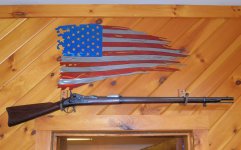
I'm a bit late to this party, but I will add my 1884 Trapdoor to the list of those already shown (impressive list, by the way). At this point I don't plan on shooting this one enough to get into loading for it. I have used it with Black Hill 'cowboy' loads with no problem.
 

Attachments

  • FlagAndTrapdoor.jpg
    FlagAndTrapdoor.jpg
    84 KB
Can the Rolling Block repros take the hot Buffalo Bore rounda?
 
Back
Top