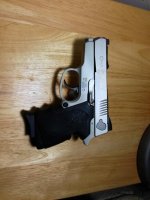
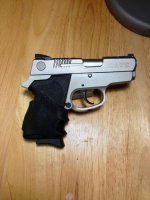
The relatively short grip frames of the CS guns could put the slide close to the web of a shooter's hand. Anybody ever experience slide-bite (Walther PPK or Glock)?
CQB's observation about having a smooth slide profile at the bottom edge of the slide is pretty spot on, I'd think. less chance of sharp slide serrations snagging (cutting) across the web of the shooter's hand.

The CS series experienced some changes and refinements over the years. I've written about some of them over the course of some previous posts I've written, here and in on other forum boards. I won't rehash all of it here, but you can search for them.
Some of the more noteworthy revisions include going from plastic sights to cast steel Novak Low mount sights, and from single side manual safeties to ambi assemblies (with may have involved changing the thickness of the CS45 slide, I believe - as it did in the TSW line).
The recoil guide rod assemblies changed a bit, too. The current ones are metal, and of the 1-piece "solid" design (no staked collar to hold a plunger & spring in the rod body), and I've seen both plastic & steel plungers used. (The newer TSW's switched over to the 1-piece rods and removeable steel plungers, BTW.)
I have both types of plungers I've used, and I sort of prefer the softer plastic plungers in my own CS45 & CS9 (for ease of field-stripping). The plastic ones can get a bit "fuzzy" after a lot of field-stripping, though (and the metals ones can sometimes develop a burred edge at the tip). Toss a coin.
The CS guns were excellent subcompact pistols, in my humble opinion. The CS40 didn't run for all that long, and the best guess I've heard from the factory is that the snappy recoil didn't appeal to as many folks as they expected. What turned out to be the last year of production for the CS40 resulted in what I was told as being less than 100 units being sold.
The CS9 & CS45 were strong sellers, though, especially among LE for off-duty weapons. They didn't require much in the way of advertising once they'd been released, selling quickly by word-of-mouth and becoming real "sleepers" on the commercial market.
As much as I've used my CS45 (early production model after they introduced the stainless version), I actually prefer my CS9. The grip frame and Hogue grip fits my hand as if made for it.
Light, nicely & "lively" balanced (more back in the hand instead of muzzle heavy), fast cycling and REALLY reliable with a wide range of factory ammunition ... and accurate. The short grip frame required them to design a new main (hammer) spring, and the trigger pull is a little on the stout side ... but the inherent and practical accuracy is really surprising for a couple of 3" & 3.25" subcompacts.
The recoil springs are specific to the CS guns within the S&W 3rd gen lineup. The CS9 uses a red painted flat wound spring and the CS45 uses a bilious green painted spring. I tend to replace mine sooner than in the larger compact & full-size guns, as these little guns develop some healthy recoil and have fast cycling ... and I just feel better erring on the side of spring replacement intervals to try and mitigate normal wear & tear. I try to replace my recoil springs every couple of cases fired (500 round cases) , give or take.
The Shield series may have replaced the CS9 & CS40 with similarly sized, thin subcompact pistols (with better grips, in the opinions of some folks
) ... but we have yet (and may not) see something come along to replace the CS45. More's the pity, I'd think.
Enjoy the CS9. Congrats.
If it were me, I'd order
factory replacement recoil & mag springs, just to start out "fresh".
Keep the alloy-framed gun properly lubed (not excessively, but not under-lubricated, either, to keep the alloy rails in good condition).
Enjoy.