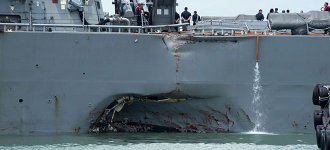
USS John McCain

This nonsense is getting too common!! *** is going on in today's Navy?

Sent from my SM-N930T using Tapatalk
 
I just posted over on the Fitzgerald thread about this collision. I guess we'll have to wait and get all the details, but I see these things through the prism of having served on even smaller vessels than a guided missle destroyer, and my sentiments are with the sailors on the ship.

Thanks for posting.

Best Regards, Les
 
We're coming up on 20 years of non-stop war. The military is worn out and preparedness suffers.
 
Just saw where the John McCain was struck port side, aft by a container ship.
I will try to post a link. 5 injured, 10 missing?
Prayers for all involved.
tb
 
At least this time the Navy ship had the right of way. If the freighter was on a crossing course it would have seen the John McCain's red running light and been obligated change course to the right to pass astern. Also, if it was over taking it would not have had the right of way.
 
My personal opinion is ships with less personal and too much relying on computers with no one watching whats going on.
My first ship had 320 men & officers, a 2300 ton short hull DD.
Multi lookouts on each watch.

BTW, a ship has to do what ever to avoid a collision no mater who has the right of way.....
 
Last edited:
Obviously, our first thoughts should be with the 10 as-yet missing sailors, who will hopefully not turn out to be fatalities.

It's too early for Monday-morning quarterbacking, but just as a general thought, one would expect people on watch to be hyper-alert these days after all the negative publicity about the Fitzgerald.

Yet once again a big, fat, slow ship, in this case a tanker that can't exactly zigzag like a jackrabbit, managed to sneak up on and hit a fast warship that's supposed to be able to detect and defend against incoming missiles.

No matter who had the right of way, that's a bit odd.
 
Given that this sort of thing doesn't happen very often, to have two in such a short period of time is mighty suspicious. Before I even finished reading the headline red flags were going off in my head. I wonder if there are folks out there that don't like us very much!
 
Not the U.S. Navy ships fault from what I'm reading.
Our ship may have had the right of way, but like the guy crossing at a crosswalk, you don't take that right of way until you know the other player is playing by the same rules. So in that sense, it was still very much the fault of people on our ship. We don't know what was going on with the ship's electronic navigation systems, but the sailors still have eyes and they should be using them.
 
At this rate we don't need to worry about the Chinese or North Koreans...the merchant navy plying the seas is taking out our warships with far greater success!!
 
USS John Mccain

How long will it be before our "leaders" realize that these collisions are no accident. They are planned acts of war.:mad:
 
Hi-Tech, No Help

I'm not a navy man but I've been exposed to boating through my fisherman father. I thought modern ships are equipped with radar and GPS and perhaps some other top secret navigation tools? I can forgive the ship's commander if his ship was lashed to a dock but when in motion, somebody has to have his head screwed on facing forward.

A special sadness and prayers for the innocent sailors who placed their faith and safety in the skipper.
 
"This is the story of Mike O’Day
Who died maintaining his right of way.
His right was clear! His will was strong.
But he’s just as dead, as if he was wrong."

This ditty was in a book on sailing that I read at my father's request. I was allowed to sail our Blue Jay alone or with a friend. Maybe it should be required reading at Annapolis.
 
There are a few issues that stand out that contribute to this kind of failure:

1) Junior officers are promoted based on “hitting the wickets". They are evaluated based on how closely they follow a highly-scripted career path, not based on how well they performed. Junior officers are rated against each other, but the system is rigged so that those with seniority in grade will almost always be ranked higher than those junior in grade, even if the officer with less time in grade is exceptional and the officer with more time in grade can barely fog a mirror.

The end result is that as long as a junior officer doesn't massively screw up to the point of getting received of duty, doesn't fail a physical fitness test, doesn't get caught fraternizing, and doesn't get convicted of a crime like domestic violence, DUI, etc he or she will probably make at least (O-4) - a Lt. Commander and equal to a Major in the Army, USMC, or Air Force.

2) With this system in mind, it takes 9 to 11 years to get promoted to Lt. Commander, but about 80% of all officers who stay that long will make that rank. That's 9-11 years before merit really starts to come into play and 15-17 years before an exceptional officer has any real edge in promotion to O-5 (Commander) over his or her mediocre peers.

The problem of course is that the real talent in the Navy has often left by that point, while many of the rest are just hanging on to make the 20 year mark before leaving for something better.

Commander is by the way the usual rank of a destroyer or frigate captain.

3) The average surface warfare officer will have 18-24 months of initial training as an Ensign in various things navy before getting an initial 30 month sea tour as a Lieutenant JG. However naval vessels tend to be at sea only about 6 months out of every 18 months. There are work ups, etc, but the majority of that 18 month "sea tour" is spent tied to a pier.

After that initial sea tour they'll be shore based for more training and then as a Lieutenant, they'll get a second 24 month sea tour as a division officer, with the vast majority of that spent tied to the pier. Then it's back to shore duty.

A Lieutenant will get another 30 months of sea duty as a second division officer tour, and then go back for another 36 months of shore duty.

As a Lt. Commander, after a few years ashore the officer will get about 24 months of sea duty, usually as an executive officer, before being promoted to Commander.

So... at this point a Commander will have 15-17 years of service, with a total of 6-7 years of sea duty, but with not much more than a 1/3rd of that actually spent underway. At best it'll be in the neighborhood of 3 years actually under way.

4) That's not a lot of sea time by merchant marine standards. The merchant marine has minimum sea time and comprehensive test standards to be promoted, and one day of "sea time" is defined as 8 hours on watch. Thus, there is no time credited unless the officer is actually standing watch aboard ship. A second or even 3rd mate aboard a large vessel will have more sea time than the captain of a US Navy destroyer.

5) There's also differences in how things work aboard a naval vessel compared to a merchant vessel. The chain of command in the USN will have ratings doing the work, supervised by petty officers who report to the division officer who reports to the officer standing watch on the bridge. Which means the rating operating the radar says "hey chief, we have a ship bearing XXX at XXX yards". The chief reports this to the officer standing watch in the CIC, who then reports it to the bridge.

In contrast on a merchant vessel the officer on watch on the bridge is also the officer watching the radar, so the chain of command and the delay is a lot shorter.

----

In summary, you have junior officers aboard destroyers who have very limited time actual under way, who are not promoted on merit or ability, but rather on staying on a prescribed track and not screwing up to the point of being relieved, they are commanded by a captain who may have as little as 3 years experience underway, and they are using a command and communication structure aboard ship that is optimized for operating on combat operations as part of a larger fleet, under orders from other vessels.

The thing to wonder about is why there are not a lot more collisions.
 
There are a few issues that stand out that contribute to this kind of failure:

1) Junior officers are promoted based on “hitting the wickets". They are evaluated based on how closely they follow a highly-scripted career path, not based on how well they performed. Junior officers are rated against each other, but the system is rigged so that those with seniority in grade will almost always be ranked higher than those junior in grade, even if the officer with less time in grade is exceptional and the officer with more time in grade can barely fog a mirror.

The end result is that as long as a junior officer doesn't massively screw up to the point of getting received of duty, doesn't fail a physical fitness test, doesn't get caught fraternizing, and doesn't get convicted of a crime like domestic violence, DUI, etc he or she will probably make at least (O-4) - a Lt. Commander and equal to a Major in the Army, USMC, or Air Force.

2) With this system in mind, it takes 9 to 11 years to get promoted to Lt. Commander, but about 80% of all officers who stay that long will make that rank. That's 9-11 years before merit really starts to come into play and 15-17 years before an exceptional officer has any real edge in promotion to O-5 (Commander) over his or her mediocre peers.

The problem of course is that the real talent in the Navy has often left by that point, while many of the rest are just hanging on to make the 20 year mark before leaving for something better.

Commander is by the way the usual rank of a destroyer or frigate captain.

3) The average surface warfare officer will have 18-24 months of initial training as an Ensign in various things navy before getting an initial 30 month sea tour as a Lieutenant JG. However naval vessels tend to be at sea only about 6 months out of every 18 months. There are work ups, etc, but the majority of that 18 month "sea tour" is spent tied to a pier.

After that initial sea tour they'll be shore based for more training and then as a Lieutenant, they'll get a second 24 month sea tour as a division officer, with the vast majority of that spent tied to the pier. Then it's back to shore duty.

A Lieutenant will get another 30 months of sea duty as a second division officer tour, and then go back for another 36 months of shore duty.

As a Lt. Commander, after a few years ashore the officer will get about 24 months of sea duty, usually as an executive officer, before being promoted to Commander.

So... at this point a Commander will have 15-17 years of service, with a total of 6-7 years of sea duty, but with not much more than a 1/3rd of that actually spent underway. At best it'll be in the neighborhood of 3 years actually under way.

4) That's not a lot of sea time by merchant marine standards. The merchant marine has minimum sea time and comprehensive test standards to be promoted, and one day of "sea time" is defined as 8 hours on watch. Thus, there is no time credited unless the officer is actually standing watch aboard ship. A second or even 3rd mate aboard a large vessel will have more sea time than the captain of a US Navy destroyer.

5) There's also differences in how things work aboard a naval vessel compared to a merchant vessel. The chain of command in the USN will have ratings doing the work, supervised by petty officers who report to the division officer who reports to the officer standing watch on the bridge. Which means the rating operating the radar says "hey chief, we have a ship bearing XXX at XXX yards". The chief reports this to the officer standing watch in the CIC, who then reports it to the bridge.

In contrast on a merchant vessel the officer on watch on the bridge is also the officer watching the radar, so the chain of command and the delay is a lot shorter.

----

In summary, you have junior officers aboard destroyers who have very limited time actual under way, who are not promoted on merit or ability, but rather on staying on a prescribed track and not screwing up to the point of being relieved, they are commanded by a captain who may have as little as 3 years experience underway, and they are using a command and communication structure aboard ship that is optimized for operating on combat operations as part of a larger fleet, under orders from other vessels.

The thing to wonder about is why there are not a lot more collisions.

Absolutely true. There was a telling essay in USNI Proceedings a few years ago by an O-3 on a rotation with the Royal Navy (an RN O-3 is seconded to the USN Winston Churchill and an USN O-3 to the RN in exchange) contrasting the bridge crew in the RN with the USN on a comparable ship. The USN as mentioned above, has a long line of communication up and back. In contrast, the RN has the Officer of the Watch (OOW) speaking directly to the helmsman and vice versa. In addition, the OOW in the RN has both the Naval qualification but also a First Mate's ticket in Navigation / Ship-handling in the Merchant Marine before s/he is allowed to be the OOW. The old adage "too many cooks..." comes to mind. Dave_n
 
I suspect that this second incident may cause repercussions much further up the chain of command than the earlier Fitzgerald incident'

"In summary, you have junior officers aboard destroyers who have very limited time actual under way, who are not promoted on merit or ability, but rather on staying on a prescribed track and not screwing up to the point of being relieved'"

At least in my experience, things are much the same in the USAF. The very first time I had to write up an officer's performance report (on a recent USAFA grad 2nd Lt. working for me), it wasn't a good OPR. I could never understand how he made it through the Academy, basically a Gomer Pyle in a blue suit. The guy should have been driving a bus if he wanted to wear a uniform. Anyway, I wrote it up just the way it was, and did I hear about that in a hurry. It bounced back immediately and I was ordered to change it and to make the kid sound like a hero. Which of course I did. I also found out that there are certain "code" or "bullet" words and phrases required for OPRs, especially Academy graduates. It was a learning experience, mainly in learning that you never make anyone look bad on their OPR, no matter how much he deserves it.
 
Last edited:
Back
Top